Introduction
It is a cyber insurance coverage Silverfort. Just suppose you are a small business owner. One day, your employees are unable to find some important documents, a ransomware virus has infected your data. Your systems have been locked, business is stalled, and customers angry. The cost of financial losses begins to accumulate: lost deadlines, damaged reputation, and tremendous payment of reinstating systems.
Cyberattacks are no longer far-fetched, they are a fact and an increasing danger nowadays. As recent reports tell, credit theft and identity based attacks have taken off: in 2025 alone, a 160 percent rise in credit theft was reported worldwide.A combination of powerful identity security and cyber insurances is becoming a necessity especially to businesses who wish to secure themselves. That is where Silverfort fits in – an efficient identity security solution that can assist organizations in fulfilling their contemporary cyber insurance standards. This article describes the way Silverfort makes it easier to be covered under a cyber insurance, and demonstrates practical actions that businesses and employees should take in order to be more cyber resilient.
What Is Cyber Insurance Coverage?
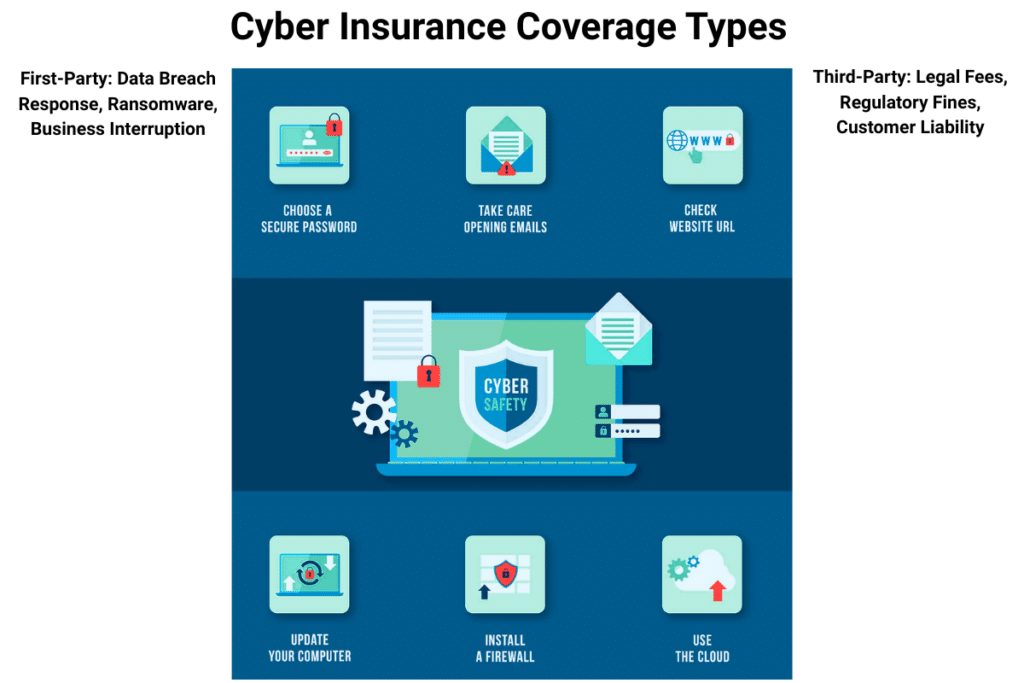
Cyber insurance (also known as cyber insurance coverage silverfort) is a coverage that covers organizations in case of a financial loss due to online threats such as cyberattacks, data breach, ransomware, and other events. Coverage normally includes:
- First‑party costs Data breach response costs, system recovery costs, ransomware costs or ransomware negotiation costs, operational downtime costs and business interruption costs.
- Third‑party costs: Expenses related to customer or partner data breaches such as legal expense, regulatory fines, settlements, and reputational damage.
As cyber threats are rising, small businesses and large organizations are increasingly buying cyber insurance as a part of their financial risk management.
Why Many Companies Struggle with cyber insurance coverage silverfort Eligibility
In the dynamic cyber eligibilit. insurance environment, insurers have increased their security clauses. A firewall or antivirus is not sufficient any longer, insurers are also enforcing robust identity security measures, particularly on privileged accounts, administration access, non human (service) accounts, as well as hybrid infrastructure (on premises and cloud).
Common gaps include:
- On-prem applications and legacy that lack support of modern security controls.
- Accounts that are non human (scripts, automatization, service user credentials) and are not regularly monitored.
- Absence of centralized logging, tracking or identity.
- Lack of MFA or weak password methods on numerous accounts.
- Silverfort identity security
These loopholes may result in an increase of insurance premiums – or even the loss of coverage.
Introducing Silverfort
There is a solution that fills these gaps called Silverfort; it is an identity security platform. Silverfort is agentless and backend-based, unlike traditional security tools which need to place an agent or proxy on each machine/app. This renders it quite appropriate in a setting that has legacy on prem systems, as well as cloud resources, hybrid infrastructure, and human and non human accounts.
How Silverfort Works
Unified MFA & Identity Protection:
- Unified MFA & Identity Protection: Silverfort implements MFA in every resource on prem, cloud, remote access, legacy applications without making system-by-system modifications.
- Comprehensive Account Discovery: It discovers all kinds of accounts human, privileged, service, non human even those that are neglected most of the time.
- Continuous Monitoring & Adaptive Access Controls: It keeps track of authentication requests and marks suspicious behavior, as well as being able to block or force further verification in real time.
- Support for Hybrid Environments: Silverfort is fully integrated with whether your infrastructure is on premises, cloud-based or a hybrid combination.
Basically, Silverfort executes an identity first security posture that is of a type of a Zero Trust approach, sealing most of the conventional gaps that are currently under investigation by cyber insurance providers.
How Silverfort Helps You Obtain and Maintain Cyber Insurance Coverage
The following is a summary of typical insurer requirements – and how Silverfort will meet them:
| Insurance Requirement / Risk | How Silverfort Helps |
| MFA/strong authentication of admin, privileged and remote access accounts | Silverfort brings MFA to all accounts and resources, no matter whether they are legacy, on prem, or remote access, without resource agents. |
| Hybrid/on prem/cloud infrastructure Unified identity protection. | Even these identities that are usually overlooked are found and captured by Silverfort. |
| Less exposure to credential based breaches and less compliance red tape among insurers. | Silverfort logs access constantly, identifies the use of credentials or lateral movement and can block malicious access in real-time. |
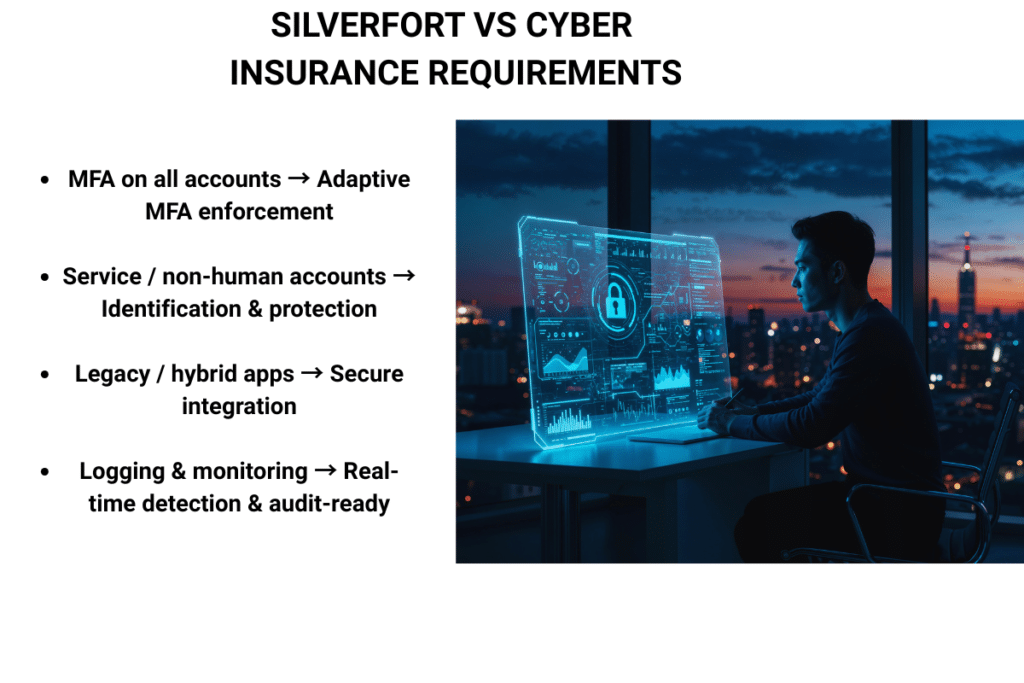
With Silverfort, organizations enhance their identity-security posture identity-security posture is easier to become eligible to obtain cyber insurance coverage, eliminating the risk of premium increases, and the threat of coverage loss.
Why This Matters for Small Businesses and Employees
t is easy to underestimate the risk when you are a small business owner or an employee in the company that does not have a dedicated security team. However, it has been statistically indicated that identity based attacks are one of the most frequent causes of breach.
- The expenses of a data breach may be massive: According to one source, the average cost of a breach is approximately US 3.86 million globally.
- The old-fashioned approaches to security with a password are becoming less and less effective: hackers use trivial passwords or stolen credentials to get access to the systems.
With the cost of identity protection, which is significantly lowered by purchasing cyber insurance, even minor organizations can greatly decrease the likelihood of financial ruin, loss of business functions, as well as harm to their reputation.
When you are considering both personal finance and business risk management, this is a component of your overall strategy, just as saving, health insurance, or property insurance.
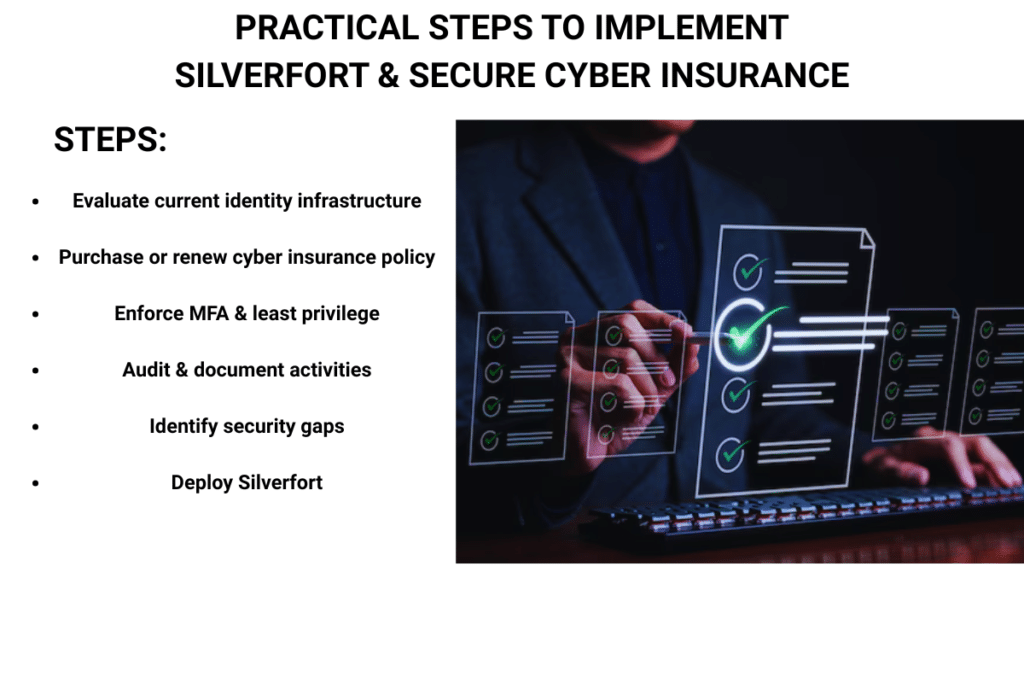
Practical Steps to Implement Silverfort and Secure Coverage
The following is an easy action oriented checklist to adopt in case you are serious in adopting cyber insurance coverage with identity security:
- Inventory your current identities and access points — List all identities and access points on-hand — include all human users, administrator and privileged accounts, service accounts, legacy applications, cloud-access, remote-access, etc.
- Assess identity security gaps — Determine the gap in identity security – with an identity assessment tool such as Silverfort, identify areas that are vulnerable (e.g. unprotected service accounts, no expiration of passwords, no MFA).
- Deploy Silverfort (or similar identity‑security solution) — Install Silverfort (or other identity security service) — as Silverfort is agentless, it may be implemented with very little disturbance.
- Document and log all identity‑security measures — Record and document all identity security — record what accounts are under a security cover, when was MFA implemented and logs of monitoring; handy in Financial Planning audit or in claims.
- Purchase/renew cyber insurance policy with updated security posture — Buy/renew cyber insurance policy with new security posture – provide your new identity security as demonstrating improved coverage and possibly reduced premiums.
- Maintain and review regularly — Keep up and check and make sure that security is not a one-time thing.
FAQs
Q1: Which types of incidents cyber insurance is provided when deployed with Silverfort?
It will depend on the policy -, usually data breaches, ransomware, loss of business, liability of the affected third parties. You are now better off preventing credential based breaches, which tend to be the cause of such attacks, with Silverfort installed.
Q2: Is Silverfort able to make my insurance premium lower?
Yes it is possible, by improving your identity security position and satisfying the requirements of insurers (MFA, privileged access controls, logging), the insurers can consider you as less risky and provide you with better premiums or terms of coverage.
Q3: Does Silverfort have a place with small businesses/startups?
Yes – particularly due to the fact that it is agentless and compatibility with legacy, on-prem, cloud, and hybrid environments. It can assist small companies to comply without their total renovation.
Q4: What is the implementation time of Silverfort?
This depends on the size and complexity of your infrastructure. However, since per device agents are not needed in Silverfort, and it can be used with existing identity providers, the deployment process is often faster and less disruptions compared to the classic PAM or identity security products.
Q5: Will I be paid out even after I have secured my identity with Silverfort through cyber insurance?
No. Insurance payout will be determined by the conditions of your policy, areas covered, circumstances of the claims, and other security best practices. Identity security is less risky- it does not mean immunity.
Conclusion
In the contemporary digital era, cyber threats are changing – and identity based attacks are considered as some of the most popular and harmful. To businesses and organizations, it is no longer sufficient to utilize simple password security.
Adopting a strong identity protection system with Silverfort, and supplementing it with cyber insurance cover, is a viable, proactive risk management solution. In the case of small business, employees or whoever is in charge of financial or operational stability this is no longer an option.
It may perhaps spare you the following attack – and the storm of money that attends it.A: Cyber insurance coverage Silverfort protecting business identity security
It may perhaps spare you the following attack – and the storm of money that attends it.
