
If you invest without a plan, it’s easy to make decisions based on whatever the market is doing that day rather than what you’re actually trying to accomplish. An investment policy statement is the tool that fixes that. In simple terms, it’s a written document that spells out your investment goals, how much risk you’re willing and able to take, and the rules you’ll follow to manage your portfolio over time.
Institutional investors — pension funds, endowments, foundations — have used investment policy statements for decades, largely because their governing boards need a documented framework for accountability. Individual investors don’t face the same legal requirements, but the underlying logic still applies: a clear plan written down in advance is easier to stick to than a plan that only exists in your head, especially when markets get volatile.
This guide walks through what an investment policy statement actually contains, why financial professionals treat it as the starting point of the portfolio-management process, and how you can put one together for your own investing, step by step.
What Is an Investment Policy Statement?
An investment policy statement, often shortened to IPS, is a written document that defines an investor’s objectives and the constraints that shape how a portfolio should be built and managed. It typically covers two broad categories: objectives (what you’re trying to achieve, in terms of return and risk) and constraints (the practical limits you’re operating under, such as time horizon, liquidity needs, taxes, and any legal or personal restrictions).
The CFA Institute — the organization that sets the curriculum for the Chartered Financial Analyst designation — identifies the investment policy statement as the foundation of the entire portfolio-management process. Before an investor or advisor selects a single stock, bond, or fund, the IPS is supposed to establish what the portfolio is for and what boundaries it has to operate within.
Individual vs. Institutional IPS
Institutional investment policy statements tend to be long, formal documents. A pension fund’s IPS might specify the roles of trustees, investment committees, and outside managers, along with detailed rules on permitted asset classes, benchmark selection, and reporting requirements. These documents often exist partly because of fiduciary duties owed to plan participants or beneficiaries.
An individual investor’s IPS can be much simpler — often just one or two pages. It doesn’t need legal language or committee structures. What it needs is honesty: a realistic statement of your goals, your actual tolerance for risk (not the risk tolerance you wish you had), and the practical constraints on your money, such as when you’ll need to access it and how it’s taxed.
Neither version is required by law for a personal investor. The value comes from what the process forces you to think through before you commit money to the market, not from any regulatory obligation to have one.
Why Is an Investment Policy Statement Important?
An IPS matters less for what it says on the page and more for what it prevents you from doing in the moment.
It creates a structured framework instead of ad hoc decisions. Without a plan, portfolio decisions tend to be reactive — chasing whatever performed well recently or panic-selling after a downturn. An IPS forces you to define your approach in advance, when you’re thinking clearly, rather than in the middle of a market swing.
It defines objectives in specific, measurable terms. “I want to grow my money” isn’t an objective an advisor, or you, can actually plan around. “I want to accumulate enough to replace 70% of my income at age 65” is something you can build a portfolio toward.
It establishes risk parameters before you need them. Risk tolerance is easy to overstate when markets are calm and just as easy to abandon when they’re not. Writing it down ahead of time — and distinguishing between your willingness to take risk and your actual capacity to absorb losses — gives you a reference point that isn’t influenced by that week’s headlines.
It provides an anchor during market volatility. This is arguably the most practical benefit. The CFA Institute has noted that an IPS can serve as an objective policy guide during periods of market disruption, which helps reduce the influence of fear-driven or instinctive decisions. When markets drop sharply, an investor with a written plan has something concrete to check their reaction against — “does this decline actually change my time horizon or goals?” — instead of making a decision purely on emotion.
None of this guarantees better investment returns. What it does is reduce the odds that you’ll abandon a reasonable strategy at the worst possible time.
What Should an Investment Policy Statement Include?
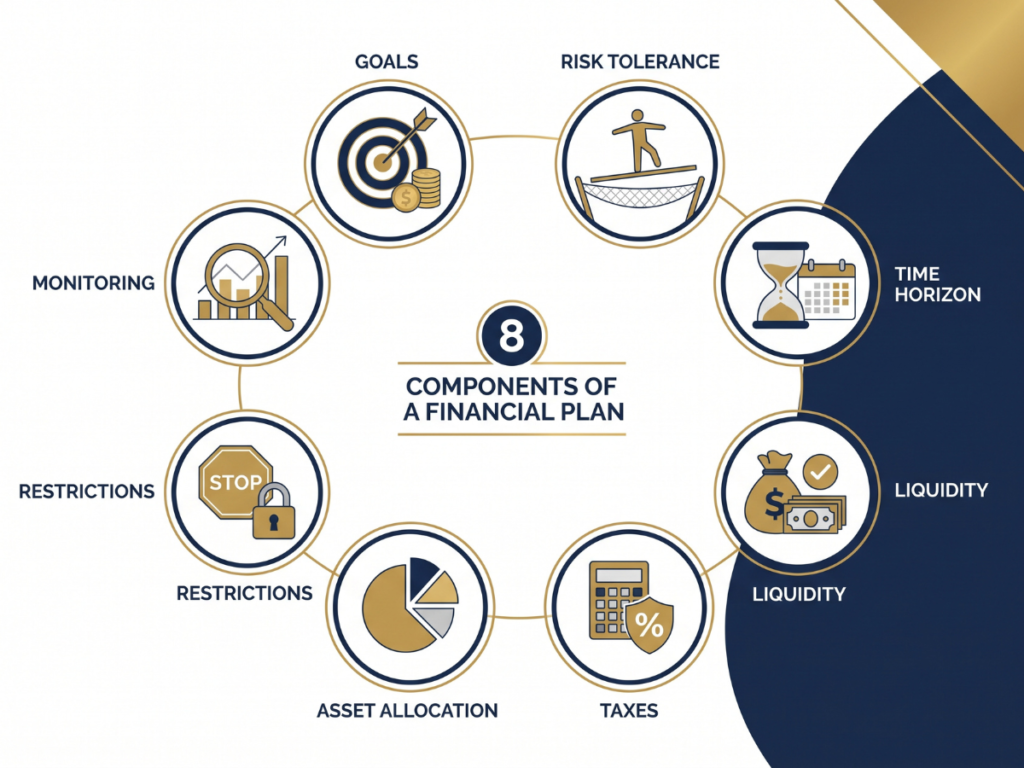
A well-built IPS generally addresses eight areas. Institutional documents may go into far more depth on each, but for an individual investor, these are the components worth thinking through carefully.
Investment Goals and Objectives
Start with what the money is actually for: retirement income, a home down payment, funding education, or general wealth accumulation. Objectives are usually expressed in terms of a return requirement — either an absolute target (for example, “average 6% annually over the long term”) or a relative one (for example, “track a benchmark such as a 60/40 stock-and-bond index”). Whichever approach you use, the objective should be realistic given your time horizon and risk tolerance, not aspirational.
Risk Tolerance
Risk tolerance in an IPS usually has two parts: your willingness to take risk (a psychological and behavioral factor — how you actually react to losses) and your capacity to take risk (a financial factor — how much loss you can absorb without jeopardizing your goals). These two don’t always match. Someone with a stable income and decades until retirement may have a high capacity for risk even if they feel anxious watching account balances drop. An honest IPS accounts for both, rather than defaulting to whichever number feels more comfortable to write down.
Time Horizon
Time horizon is the length of time your money will be invested before you need to draw on it. A 30-year-old saving for retirement has a fundamentally different time horizon than someone saving for a house down payment in three years, even if both consider themselves “moderate risk” investors. Many investors actually have multiple, overlapping time horizons — for example, a shorter horizon for near-term goals and a much longer one for retirement — and a good IPS can note that rather than treating time horizon as a single number.
Liquidity Needs
Liquidity refers to how easily you can convert investments into cash without a significant loss of value. This section should identify any known upcoming cash needs — an emergency fund, a planned purchase, required minimum distributions in retirement — so the portfolio isn’t fully invested in assets that are difficult to sell quickly when you actually need the money.
Tax Considerations
Taxes affect after-tax returns, and they vary based on account type and your personal tax situation. Money held in a traditional IRA or 401(k), a Roth account, and a regular taxable brokerage account are all taxed differently. An IPS doesn’t need to function as a tax plan, but it should note which accounts you’re investing through and any tax-related preferences, such as prioritizing tax-efficient funds in a taxable account.
Asset Allocation
Asset allocation — how your portfolio is divided among stocks, bonds, cash, and other asset classes — is where your objectives and constraints translate into an actual investment strategy. This is typically expressed as target percentages (for example, 70% stocks, 25% bonds, 5% cash) along with acceptable ranges around those targets. The allocation should logically follow from everything above it in the document; a 25-year-old with a decades-long time horizon and high risk capacity will generally support a different allocation than someone five years from retirement.
Investment Restrictions
This section lists anything you specifically want to avoid or require. That might include excluding certain industries for personal or ethical reasons, avoiding individual stocks in favor of diversified funds, or setting a maximum position size in any single holding. Institutional investors sometimes call these “unique circumstances” or constraints tied to a client’s specific situation, but the underlying idea is the same: not every investor’s plan looks identical, and legitimate personal preferences belong in the document.
Monitoring and Rebalancing
An IPS should specify how and when the portfolio will be reviewed, and under what conditions it will be rebalanced back to its target allocation. A common approach is a calendar-based review (such as annually) combined with a threshold rule (such as rebalancing if an asset class drifts more than five percentage points from its target). Without this section, a written asset allocation tends to drift over time as some investments grow faster than others, gradually shifting the portfolio’s actual risk level away from what was originally intended.
Investment Policy Statement Example
The following is a simplified, hypothetical example for illustration only. It is not a template to copy without adjustment — a real IPS should reflect your specific numbers, goals, and constraints.
Investor: Fictional individual, age 35, saving for retirement at age 65.
- Objective: Accumulate sufficient assets to generate approximately $60,000 per year in retirement income (in addition to expected Social Security benefits), assuming a 30-year retirement.
- Risk tolerance: Moderate-to-high willingness to accept volatility; high capacity for risk given stable employment income and a 30-year time horizon.
- Time horizon: 30 years to retirement, with a secondary shorter-term horizon for a 3-year emergency-fund target.
- Liquidity needs: Emergency fund of 6 months’ expenses held outside the retirement portfolio in cash or cash equivalents; no other near-term withdrawals expected from the investment portfolio.
- Tax considerations: Contributions split between a 401(k) and a Roth IRA; taxable brokerage account used only after retirement accounts are fully funded for the year.
- Asset allocation target: 80% equities (diversified across U.S. and international funds), 15% bonds, 5% cash, with a rebalancing range of plus or minus 5 percentage points.
- Restrictions: No individual stock positions exceeding 5% of the portfolio; no use of leverage or margin.
- Monitoring and rebalancing: Portfolio reviewed annually each January, and rebalanced whenever any asset class drifts more than 5 percentage points from its target.
This example is deliberately simple. A real investor’s document might add more detail on specific funds, benchmarks, or account structures, but the core logic — objectives first, then constraints, then a resulting allocation and review process — stays the same.
How to Create an Investment Policy Statement
Building your own IPS follows a fairly consistent sequence:
- Define your investment goals. Be specific about what you’re investing for and roughly when you’ll need the money. Vague goals produce vague plans.
- Establish your time horizon. Note the horizon for each major goal separately if you’re saving for more than one thing at different points in the future.
- Assess risk tolerance and risk capacity. Consider both how you’re likely to react to a significant market decline and how much of a decline your finances could actually absorb without derailing your goals.
- Identify liquidity requirements. List any cash needs you can reasonably anticipate, including an emergency fund, so the portfolio isn’t structured in a way that forces you to sell investments at an inopportune time.
- Consider tax and other constraints. Note the account types you’re using and any legal, personal, or ethical restrictions relevant to your investments.
- Establish an asset-allocation framework. Translate everything above into target percentages across asset classes, along with a reasonable range around each target.
- Define monitoring and rebalancing rules. Decide in advance how often you’ll review the portfolio and what will trigger a rebalance, so future decisions are based on a rule you set today rather than a reaction to today’s headlines.
Writing the document is the easy part. The harder, more valuable part is being honest in each step rather than writing down the version of yourself you’d like to be.
Investment Policy Statement vs. Investment Plan
These terms are sometimes used loosely and interchangeably, but they describe different things.
An investment policy statement is a foundational document focused on objectives and constraints — the “why” and the “boundaries” behind your investing. It answers questions like: What are you investing for? How much risk can you tolerate? What restrictions apply?
An investment plan (sometimes called a financial plan or investment strategy) is typically broader and more action-oriented. It may include the specific funds or securities you’ll hold, a savings schedule, retirement projections, insurance considerations, and estate planning elements, in addition to the investment component itself.
In practice, the IPS often functions as one input into a larger investment or financial plan. The IPS sets the guardrails; the plan describes the specific route you’ll take within them.
How Often Should You Review an Investment Policy Statement?
An investment policy statement isn’t meant to be written once and filed away permanently. It should be revisited when something material changes — not on an arbitrary fixed schedule just for the sake of activity.
Reasonable triggers for a review include a significant change in income or employment, a shift in your time horizon (for example, retirement moving from 20 years away to 5), a major life event such as marriage, divorce, or the birth of a child, a meaningful change in your risk tolerance, or a change in tax law or account structure that affects your investing. Many investors also do a routine annual check simply to confirm that nothing has changed and the plan is still on track, even if no major life event has occurred.
The goal is to keep the document aligned with your actual circumstances. An IPS that no longer reflects your real goals or constraints isn’t providing much value — it’s just a piece of paper.
Common Investment Policy Statement Mistakes
A few recurring mistakes undermine the usefulness of an IPS:
- Setting unrealistic return expectations. An objective that assumes returns well above long-term historical averages sets the entire plan up to fail or encourages excessive risk-taking to try to hit an unrealistic number.
- Ignoring liquidity needs. A portfolio that’s fully invested with no accessible cash can force an investor to sell assets during a downturn simply to cover an unexpected expense.
- Ignoring taxes. Treating a taxable account, a traditional retirement account, and a Roth account identically can lead to avoidable tax drag on returns.
- Taking more risk than the investor can actually tolerate. An allocation built around risk capacity while ignoring risk willingness (or vice versa) often ends with the investor abandoning the plan during a market decline.
- Having no rebalancing framework. Without rules for rebalancing, a portfolio’s actual risk level tends to drift upward during bull markets, right when a correction becomes more likely.
- Using a generic template without adapting it. A downloaded template filled out mechanically, without real thought about your specific goals and constraints, rarely reflects your actual situation. The CFA Institute’s guidance on this point is consistent: an IPS is meant to be customized to the individual investor, not applied as a one-size-fits-all document.
Frequently Asked Questions
Q.1 What is an investment policy statement?
An investment policy statement is a written document that defines an investor’s objectives — return and risk — and the constraints that shape how their portfolio should be managed, including time horizon, liquidity needs, taxes, and any legal or personal restrictions.
Q.2 Do individual investors need an investment policy statement?
There’s no legal requirement for individual investors to have one. That said, many financial professionals consider it a useful discipline, since it forces you to define your goals and risk tolerance in writing before you start making investment decisions, rather than figuring it out reactively as markets move.
Q.3 What are the main components of an IPS?
The core components typically include investment goals and objectives, risk tolerance (both willingness and capacity), time horizon, liquidity needs, tax considerations, target asset allocation, any investment restrictions, and a monitoring and rebalancing framework.
Q.4 Is an investment policy statement legally required?
For most individual investors, no. Legal or fiduciary requirements to maintain a formal IPS are more common in institutional contexts, such as pension funds or trusts, where trustees have specific duties to beneficiaries. Individual investors adopt an IPS voluntarily, as a planning tool rather than a legal obligation.
Q.5 Can I create an investment policy statement myself?
Yes. A personal IPS doesn’t need to be a complex legal document. Many individual investors write a simple one- or two-page version covering their goals, risk tolerance, time horizon, and target allocation. A financial advisor can help refine one, but the basic exercise is something you can start on your own.
Q.6 How often should an IPS be reviewed?
Review it whenever something material changes — a shift in income, time horizon, major life event, or risk tolerance — and consider a routine check at least once a year even if nothing significant has happened, just to confirm the plan still matches your circumstances.
Key Takeaways
An investment policy statement isn’t a legal requirement for individual investors, but it serves a practical purpose: it turns vague intentions (“invest for retirement,” “don’t take too much risk”) into specific, written objectives and constraints that guide actual decisions. The most useful IPS is one built honestly — realistic about return expectations, clear-eyed about risk tolerance versus risk capacity, and specific about liquidity needs and taxes — and revisited whenever your circumstances genuinely change.
This article is for educational and informational purposes only and should not be considered personalized financial, tax, or investment advice. Financial decisions should be based on your individual circumstances and, when appropriate, discussed with a qualified professional.
About the Author
Asad Alvii is a personal finance writer focused on U.S. banking, savings products, and practical financial decision-making. He researches rates, fees, account requirements, and consumer-focused banking information using reputable financial and official sources.