

If you’ve ever wondered where funding comes from for the next big breakthrough in artificial intelligence, semiconductors, or renewable energy, you’re not alone. Many everyday investors feel uncertain about what an advanced technology investment company actually does — and whether it belongs in their portfolio.
Unlike traditional mutual funds or broad index funds, an advanced technology investment company focuses specifically on emerging and innovation-driven sectors. That sounds exciting, but it also raises real questions about risk, time horizon, and realistic returns.
By the end of this guide, you’ll clearly understand what an advanced technology investment company is, how it works in real life, what risks are involved, and whether it makes sense for your long-term financial goals.
What an Advanced Technology Investment Company Really Means in Everyday Investing
An advanced technology investment company is a firm that pools investor money and directs it into cutting-edge technology sectors.
These may include:
- Artificial intelligence (AI)
- Semiconductor manufacturing
- Biotechnology innovation
- Clean energy technology
- Quantum computing
- Cloud and data infrastructure
The key difference from a regular tech fund is focus. While a broad tech ETF may invest in large established companies like Apple or Microsoft, an advanced technology investment company often targets earlier-stage innovation or highly specialized technology segments that could shape the next decade.
In simple terms:
An advanced technology investment company collects capital from investors and allocates it into high-growth, innovation-driven technology ventures, often with a long-term investment horizon and higher volatility than traditional funds.
That long-term and higher-volatility part is important. Growth potential is higher — but so is uncertainty.

How an Advanced Technology Investment Company Works Step by Step (Real-Life Flow)
Understanding the mechanics helps you decide whether this investment approach fits your situation.
Step 1: Raising Capital
An advanced technology investment company raises money through:
- Venture capital funds
- Private equity funds
- Publicly traded ETFs
- Technology-focused mutual funds
For everyday investors, access usually comes through public tech ETFs or mutual funds, which may allow entry with $100 to $1,000 depending on your brokerage.
Private technology funds often require $25,000–$100,000+ minimum investment and may require you to qualify as an accredited investor under SEC rules.
Step 2: Research and Selection
Professional analysts evaluate:
- Market demand
- Competitive positioning
- Technical feasibility
- Financial projections
These firms often see opportunities before they become mainstream. That early access can create strong returns — but it also increases risk.
Step 3: Investment Deployment
The company invests in:
- Private startups
- Publicly traded advanced tech firms
- Diversified innovation portfolios
Unlike a passive index fund, many advanced technology investment companies actively manage their holdings.
Step 4: Long-Term Management
Patience is essential.
Advanced technology investments typically require 5–10 years to fully mature. Market swings of 20–30% in a single year are not unusual.
This is not a short-term trading strategy.
Step 5: Exit and Returns
Returns may come from:
- IPOs
- Acquisitions
- Strategic sales
- Portfolio rebalancing
Management fees typically range between 0.5% and 3% annually, depending on the structure.
Fees matter more than many beginners realize. Over 10–20 years, even a 1% difference can significantly reduce total returns.
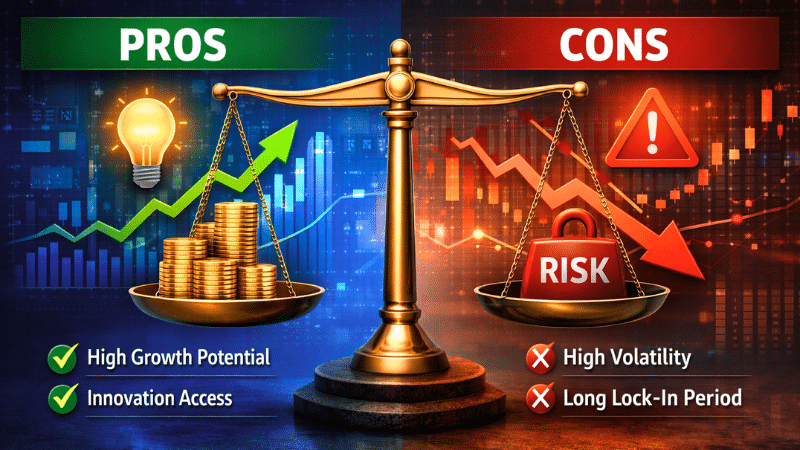
Pros and Cons of an Advanced Technology Investment Company
| Pros | Cons |
| Access to emerging innovation | Higher volatility |
| Professional research and management | Long holding periods |
| Diversification within tech | Management fees |
| Strong long-term growth potential | Liquidity limits (private funds) |
| Exposure to future-focused sectors | Greater emotional pressure during downturns |
There is no free growth. Higher upside usually comes with higher stress.
A Realistic Example Using Simple Numbers
Let’s say you invest $10,000 into an advanced technology ETF with a 10-year horizon.
Over a decade, your returns might look something like this:
- Two strong growth years (+20–25%)
- Two negative years (-15% to -20%)
- Several moderate years (+5–15%)
After 10 years, your $10,000 could grow to around $25,000–$27,000, averaging roughly 9–10% annually.
That’s solid long-term growth.
But during that period, your portfolio may drop 20% or more at least once. If you panic and sell during those drops, the long-term result changes completely.
This is where many beginners struggle.
Common Mistakes Beginners Make
Expecting Fast Profits
Advanced tech investing is not a get-rich-quick strategy. Sustainable returns usually take years.
Confusing Private and Public Funds
Private venture capital funds are very different from publicly traded ETFs. Liquidity, minimum investment, and risk levels vary significantly.
Selling During Market Drops
Technology sectors are volatile. Selling during downturns locks in losses instead of allowing recovery.
Overconcentrating in Tech
Putting 100% of your portfolio into advanced tech increases risk dramatically. A balanced approach is more realistic.
Ignoring Expense Ratios
A fund charging 2% annually may not seem high. But over 20 years, that fee can meaningfully reduce your total gains.

Practical Tips to Approach an Advanced Technology Investment Company Safely
Start With a Small Allocation
Consider beginning with 10–20% of your portfolio in advanced tech exposure.
Maintain a Long Time Horizon
If you need the money within five years, this may not be the right strategy.
Diversify Beyond Technology
A balanced portfolio might look like:
- 60% broad market index funds
- 20% advanced tech exposure
- 15% bonds
- 5% cash
This structure allows growth while reducing volatility.
Use Dollar-Cost Averaging
Instead of investing $10,000 at once, invest $1,000 per month over 10 months. This reduces timing risk.
Limit Emotional Checking
Checking your portfolio daily increases anxiety. For long-term investors, reviewing once or twice per year is often enough.
Frequently Asked Questions
Q1. Can regular investors access an advanced technology investment company?
Yes. Most everyday investors gain exposure through publicly traded ETFs or mutual funds that focus on advanced technology sectors.
Q2. Is this the same as venture capital?
Not always. Venture capital usually involves private investments in startups. Public tech ETFs provide indirect exposure and are far more accessible.
Q3. How risky is it compared to an S&P 500 index fund?
Generally more volatile. Advanced technology funds may swing 20–40% in a year, while broad index funds tend to move more moderately.
Q4. What is the minimum investmnt required?
Public ETFs may require only the price of one share. Private funds often require tens of thousands of dollars.
Q5. Are these investments government guaranteed?
No. Even if some firms receive government partnerships or support, there is no guarantee against loss.
Final Thoughts
An advanced technology investment company can be a valuable part of a long-term investment strategy — but only if you understand the tradeoffs.
It may make sense if you:
- Have a 5–10+ year timeline
- Can tolerate volatility
- Maintain diversification
- Invest with realistic expectations
It may not make sense if you need short-term stability or guaranteed income.
Technology investing rewards patience more than excitement.
Disclaimer
This article is for informational purposes only and does not constitute financial advice.
