

If you’re trying to figure out what GPA you need for investment banking, the short answer is: most bulge-bracket and elite boutique banks look for a GPA of roughly 3.5 or higher, with some groups effectively expecting closer to 3.7. That said, GPA is a screening tool, not the whole story — internships, networking, and interview performance often matter just as much once you clear the initial bar.
This article breaks down what different GPA levels realistically mean for investment banking recruiting, what happens if your GPA falls below 3.5, and how school, major, and experience factor into the decision alongside your transcript.
Author: Asad is a Personal Finance & Career Education Writer focused on investing, banking, financial careers, and practical financial education. He creates research-based content to help students, graduates, and everyday readers better understand financial careers and important money-related decisions. This article is educational in nature and reflects patterns commonly reported by recruiting professionals and published employer postings, not official policy from any single bank.
What GPA Do You Need for Investment Banking?
There is no single, universal GPA cutoff that applies to every bank. What recruiting professionals and campus recruiters consistently describe is a range, not a fixed number:
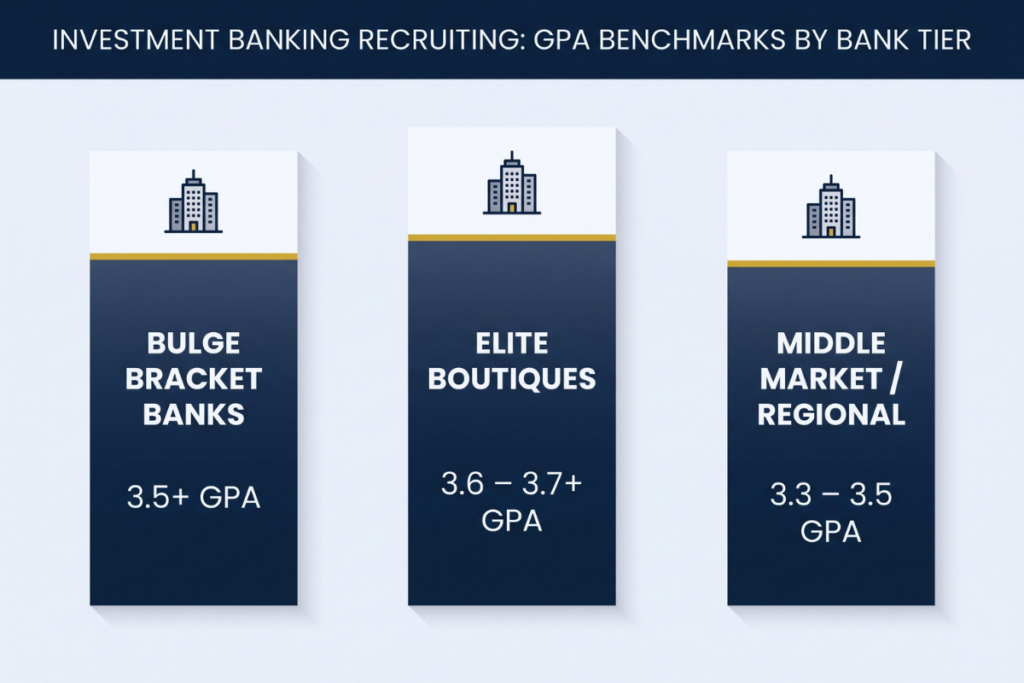
- Bulge-bracket banks (Goldman Sachs, Morgan Stanley, JPMorgan, Bank of America, Citi, and similar) generally screen resumes around a 3.5 GPA minimum, and competition at the interview stage often pushes the practical bar toward 3.6–3.7.
- Elite boutiques (Evercore, Lazard, Moelis, Centerview, and comparable firms) tend to run slightly higher, with 3.6–3.7+ often treated as the informal floor, since these firms hire far fewer analysts per cycle.
- Middle-market and regional banks are typically more flexible, sometimes accepting candidates in the 3.3–3.5 range, especially when paired with relevant experience.
It’s worth noting that GPA requirements are not identical across every job posting. For example, some of JPMorgan’s own full-time analyst postings for its Commercial & Investment Bank programs have listed a minimum cumulative GPA of 3.2 as a stated requirement, while third-party recruiting guides describe bulge-bracket norms closer to 3.5. This is a useful reminder: published minimums and competitive realities are not always the same thing, and the effective bar at interview stage is often higher than the stated minimum on a job posting.
The practical takeaway: treat 3.5 as a reasonable target for traditional investment banking recruiting, and treat anything above that as added safety margin rather than a strict requirement.
Is a 3.5 GPA Good for Investment Banking?
Yes — a 3.5 GPA is generally considered a workable, competitive baseline for investment banking recruiting, particularly from a well-regarded or target school. It clears the informal screening threshold that many bulge-bracket banks apply, meaning your resume is less likely to be filtered out automatically before a person reviews it.
That said, a 3.5 is rarely enough on its own to guarantee interviews at the most selective groups. At that GPA level, recruiters and alumni will typically weigh your internships, your major-specific coursework, and how well you can speak to markets and deals in an interview. A 3.5 with a relevant internship and strong interview prep tends to perform better in recruiting than a 3.5 with no related experience.
Is a 3.7 GPA Good for Investment Banking?
A 3.7 GPA is comfortably competitive across almost the entire spectrum of investment banking recruiting, including many elite boutiques and the most selective bulge-bracket groups. At this level, GPA is unlikely to be the reason an application gets filtered out.
The more useful question at 3.7 isn’t “is this good enough,” but “what else does my profile show.” Recruiters reviewing strong-GPA candidates are often trying to differentiate between many similarly qualified applicants, so internships, technical knowledge (accounting, valuation, financial modeling), and communication skills become the deciding factors rather than the transcript itself.
Is a 4.0 GPA Necessary for Investment Banking?
No. A 4.0 is impressive, but it is not a requirement, and it does not guarantee an offer. Investment banks care about a well-rounded profile — analytical ability, communication skills, resilience under pressure, and relevant experience — not just a perfect transcript.
In practice, a candidate with a 3.9 and no internships or networking history can lose out to a candidate with a 3.6 and two relevant internships, because recruiting for investment banking is as much about demonstrated interest and preparation as it is about raw academic performance. Once you’re above the informal GPA threshold for a given tier of bank, additional GPA points above that threshold tend to produce diminishing returns compared to gaining real experience.
What If Your GPA Is Below 3.5?
A GPA below 3.5 makes traditional bulge-bracket recruiting harder, but it does not automatically rule out a career in investment banking. What matters most below this threshold is your specific number, your school’s recruiting relationships, and how you compensate elsewhere in your application.
3.4 GPA
A 3.4 is close to the informal bulge-bracket cutoff and is often still viable, particularly at a target school, in a rigorous major, or with a relevant internship already on your resume. Some students in this range succeed through direct networking with alumni or bankers who can refer their resume outside the standard online application system, since automated resume screens are more likely to filter borderline GPAs before a human sees them.
3.2 GPA
At 3.2, bulge-bracket recruiting through the standard online application becomes considerably more difficult, though not impossible — especially since some banks’ own job postings have listed minimums in this range for certain programs. Middle-market banks, regional boutiques, and smaller advisory firms are often more realistic entry points at this GPA level, and many of them lead to strong long-term careers and credible exit opportunities.
3.0 GPA
A 3.0 is generally treated as a meaningful obstacle for traditional campus recruiting into bulge-bracket investment banking. It does not close the door entirely, but it typically requires a different strategy: leaning heavily on networking, off-cycle internships, smaller firms, or building a track record after graduation (for example, through a related role, a professional certification, or a master’s program) before attempting to break in.
Below 3.0
Below a 3.0, most standard investment banking recruiting pipelines — particularly at bulge-bracket and elite boutique firms — become very unlikely to work through conventional applications. Realistic paths at this level usually involve building relevant experience first (in accounting, corporate finance, or a related field), improving academic standing through additional coursework or a graduate program, and using that improved profile to re-enter recruiting later, often through direct relationships rather than online applications.
Can You Get Into Investment Banking With a Low GPA?
Yes, it happens — but it usually requires a deliberate strategy rather than simply applying and waiting. Recruiting professionals commonly point to several factors that can offset a below-threshold GPA:
- Target vs. non-target school: A GPA that would raise questions from a non-target school may be viewed more flexibly if it comes from a school where a bank recruits heavily and has an established alumni presence.
- Major difficulty: A GPA earned in a demanding major (engineering, physics, computer science, or a rigorous finance/economics track) is sometimes interpreted differently than the same number in a less quantitative major, since recruiters may factor in relative course difficulty.
- Relevant internships: A finance, accounting, or corporate development internship on your resume signals real interest and some baseline skill, which can matter more to an interviewer than an extra 0.1 or 0.2 on your GPA.
- Networking: Direct outreach to alumni, bankers, and recruiters can get a resume in front of a person rather than an automated filter, which matters most for candidates near or below the typical cutoff.
- Technical preparation: Being able to walk through accounting relationships, a basic DCF, or comparable company analysis confidently in an interview can offset early doubts created by GPA.
- Leadership and extracurriculars: Roles in finance clubs, case competitions, or campus organizations demonstrate initiative and can round out a thinner academic profile.
- Upward GPA trend: A GPA that started lower and has clearly improved each semester is often viewed more favorably than a flat or declining trend at the same overall average, since it suggests growth rather than a ceiling.
None of these factors guarantees an offer, and a low GPA still represents a real disadvantage in a recruiting process built around efficient screening. But recruiting guidance consistently frames GPA as one input among several — contextual rather than absolute — which is why school, major, and experience are always discussed alongside the number itself.
Does Your College or University Matter for Investment Banking?
Yes, and this is closely tied to the GPA conversation. Investment banks tend to recruit more heavily — through on-campus presentations, formal interview pipelines, and established alumni networks — at a defined list of “target schools,” which vary by bank rather than being a fixed universal list. A strong GPA from a target school with an active recruiting pipeline generally opens more doors than the same GPA from a school with no formal banking pipeline.
This does not mean students from non-target schools are excluded. It does mean that non-target candidates typically need to work harder to get visibility, most often through direct networking, off-cycle applications, or building a highly relevant internship history that compensates for the lack of on-campus infrastructure.
Do Internships Matter More Than GPA?
Once a candidate clears the informal GPA screen for a given bank or tier, internships often become the more decisive factor. GPA functions primarily as a filter to narrow a large applicant pool; internships and prior finance experience are what recruiters and interviewers actually discuss when deciding between similarly qualified candidates.
A student with a solid but unspectacular GPA and one or two relevant internships (equity research, corporate finance, a boutique bank, or even a rigorous case-based extracurricular) is frequently in a stronger position than a student with a marginally higher GPA and no directly relevant experience. Internships also give candidates concrete material to discuss in behavioral and technical interviews, which GPA alone cannot provide.
Does Your Major Matter for Investment Banking?
Major is not a strict requirement — investment banks hire from finance, economics, accounting, mathematics, engineering, and liberal arts backgrounds alike. What tends to matter more is whether the candidate can demonstrate quantitative reasoning and clear communication, regardless of major.
That said, a finance, economics, or accounting major can make certain technical interview questions more familiar territory, and some recruiters informally weigh GPA differently depending on how rigorous or quantitative the underlying coursework was. Students from non-business majors are generally expected to demonstrate technical readiness (accounting basics, valuation concepts) through self-study or coursework rather than assuming it will be assumed from their major alone.
How Investment Banks Evaluate Candidates
GPA is one input in a broader evaluation, and official recruiting materials from major banks emphasize this directly. Goldman Sachs‘ published campus recruiting materials describe the qualities the firm looks for in analyst and summer analyst candidates as centering on communication and interpersonal skills, teamwork, a commitment to excellence, leadership, intellectual curiosity and self-motivation, and integrity and sound judgment — not a GPA figure in isolation.
Similarly, published full-time analyst postings from JPMorgan’s investment banking and markets programs typically list a combination of analytical and quantitative ability, problem-solving skills, strong communication, adaptability, and a genuine interest in financial markets, alongside a stated minimum GPA that has appeared as low as 3.2 on some program listings.
The pattern across major banks is consistent: GPA sets an initial filter, but the qualities banks say they evaluate afterward are analytical thinking, communication, resilience, and motivation — not academic performance alone.
GPA vs. Internships vs. Networking
| Factor | What it primarily signals | When it matters most |
|---|---|---|
| GPA | Baseline academic discipline; used as an early screening filter | Resume screening stage, especially through online applications and ATS systems |
| Internships | Real exposure to finance work, technical readiness, genuine interest | Once GPA clears the initial screen; heavily weighed in interviews |
| Networking | Demonstrated initiative; a way to route a resume around automated filters | Especially valuable for GPAs near or below the informal cutoff, or at non-target schools |
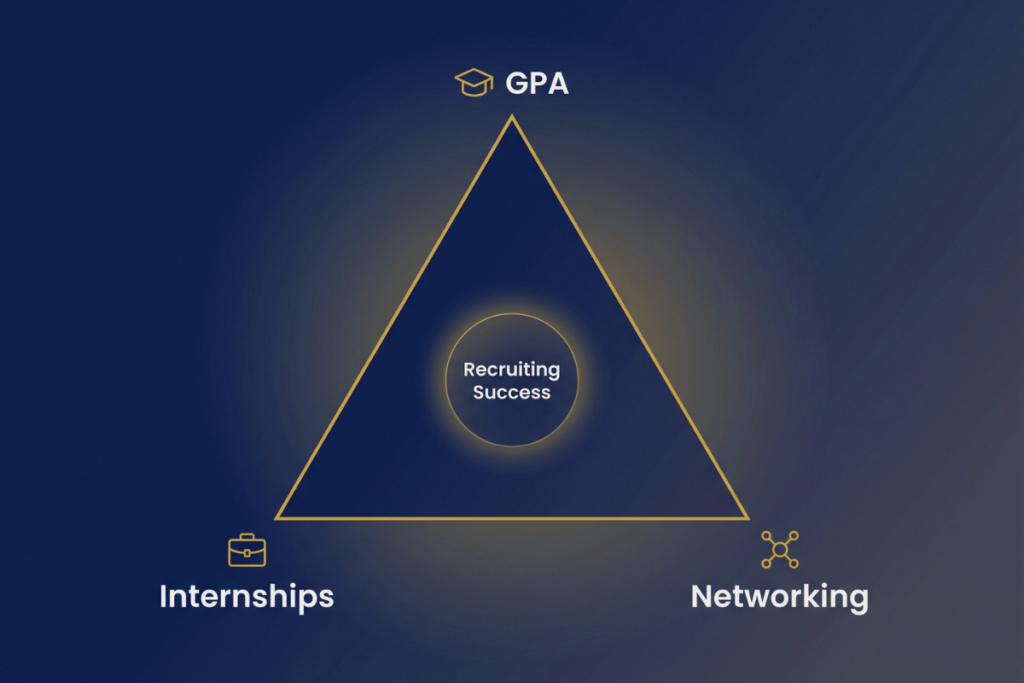
None of these three factors works well in complete isolation. A strong GPA with no experience or connections can stall at the interview stage; strong networking with a GPA far below a bank’s threshold may still hit a hard screening wall; and internships alone rarely appear on a resume without some GPA context attached. The strongest applications tend to treat all three as complementary, not substitutes for one another.
What GPA Should You Put on Your Resume?
There is no single universal rule here, and requirements can vary by bank and by application. As a general practice commonly recommended by career-services offices and recruiting professionals:
- If your overall GPA is at or above the range considered competitive for the tier of bank you’re targeting (often around 3.5 or higher for bulge-bracket and elite boutique recruiting), including it is usually straightforward.
- If your overall GPA is noticeably below that range but your major GPA or GPA in relevant, quantitative coursework is meaningfully stronger, some students choose to list the major GPA alongside or instead of the cumulative GPA, since this can more accurately reflect performance in relevant coursework — though this should be done transparently, not in a way that appears to obscure the overall number.
- If your GPA is low enough that omitting it is a realistic option (commonly discussed as below 3.0 for competitive finance recruiting), some students choose not to list it at all. Recruiters are generally aware that omitting GPA suggests it isn’t a strength, and candidates should be prepared to discuss it honestly if asked directly in an interview.
Whatever you decide, accuracy matters. Misrepresenting your GPA on a resume is a integrity issue that can end an offer or a career before it starts, regardless of how competitive your GPA is.
How to Improve Your Investment Banking Profile With a Lower GPA
If your GPA falls below the range you’re targeting, a lower number does not have to be the end of the conversation. Consider focusing on the following, roughly in order of practical impact:
- Show an upward GPA trend. Strong, improving grades in your junior and senior year can matter more than an early dip, especially if you can point to specific reasons for the improvement.
- Get relevant internships, even if they’re at smaller firms, family offices, or in adjacent roles like corporate finance or accounting, to build real experience and interview material.
- Build accounting and valuation knowledge on your own — through self-study, online coursework, or finance club projects — so you can speak confidently about financial statements, DCF analysis, and comparable company analysis in interviews.
- Network deliberately with alumni and bankers through informational conversations, rather than relying solely on the standard online application process.
- Prepare specifically for technical interviews, since strong technical answers can offset early doubts created by a lower GPA.
- Build a resume that foregrounds strengths — leadership roles, case competition results, relevant coursework, and any quantitative achievements — rather than centering the GPA number itself.
- Apply strategically across bulge-bracket, middle-market, and boutique firms rather than only targeting the most selective names, since middle-market and regional banks are often more flexible on GPA and can lead to strong long-term careers.
Frequently Asked Questions
Q.1 What GPA do I need for investment banking?
Most bulge-bracket and elite boutique banks informally screen resumes around a 3.5 GPA or higher, though the specific threshold varies by bank, group, and recruiting cycle. Some published job postings have listed minimums as low as 3.2, while competitive interview outcomes often favor candidates closer to 3.6–3.7.
Q.2 Is a 3.6 GPA bad for investment banking?
No. A 3.6 GPA is generally considered solid and typically clears the informal screening threshold at most banks. At this level, recruiters tend to focus more on internship experience, technical preparation, and interview performance than on the GPA itself.
Q.3 Is a 3.5 GPA good for investment banking?
Yes, a 3.5 is generally treated as a competitive baseline, particularly from a target school. It’s rarely a guarantee on its own, but it typically avoids automatic filtering and puts the focus on the rest of your application.
Q.4 Is a 3.7 GPA good for investment banking?
Yes. A 3.7 is comfortably competitive across most of the industry, including many elite boutiques, and is unlikely to be a limiting factor in recruiting.
Q.5 Is a 3.4 GPA good for investment banking?
A 3.4 is close to the typical informal cutoff and can still be workable, especially with a target-school pipeline, a rigorous major, relevant internships, or strong networking. It’s a borderline case rather than a clear pass or fail.
Q.6 Can you get into investment banking with a 3.0 GPA?
It’s possible but considerably more difficult through standard campus recruiting. Candidates in this range often rely more heavily on networking, middle-market or boutique firms, and building relevant experience to offset the lower GPA.
Q.7 Is a 4.0 GPA necessary for investment banking?
No. A 4.0 is impressive but not required, and banks evaluate candidates on a full profile that includes internships, communication skills, and technical readiness, not academic performance alone.
Q.8 Does GPA matter for investment banking internships?
Yes, often more so than for later-stage or full-time hiring in some cases, since internship recruiting is typically the primary funnel into the industry and applicant volume is extremely high. A strong GPA is one of the more common ways banks narrow that volume at the resume-screening stage.
Key Takeaways
- There is no single official GPA cutoff across the industry, but roughly 3.5 or higher is a common informal benchmark for bulge-bracket and elite boutique recruiting.
- A 3.7 is comfortably competitive across nearly the entire industry; a 4.0 is impressive but not required.
- GPAs below 3.5, and especially below 3.0, make traditional recruiting harder but do not eliminate every path into the industry.
- Target school status, major rigor, internships, and networking all interact with GPA rather than replacing it entirely.
- Once GPA clears a bank’s informal threshold, internships, technical preparation, and communication skills typically become the deciding factors.
If you’re earlier in your academic career, the most useful move is usually to protect your GPA where reasonably possible while building relevant experience in parallel — rather than treating the two as separate, sequential goals.
Financial Disclaimer: This article is for educational and informational purposes only and should not be considered personalized career, financial, or admissions advice. GPA thresholds, recruiting practices, and hiring standards vary by bank, program, and recruiting cycle, and can change over time. Readers should verify current requirements directly with individual banks’ official career pages and, where appropriate, consult a career services professional or academic advisor for guidance specific to their situation.
Author Bio
Asad is a Personal Finance & Career Education Writer focused on investing, banking, financial careers, and practical financial education. He creates research-based content that helps students, graduates, and everyday readers better understand financial careers, investment banking, and important money-related decisions. His writing emphasizes clear explanations, reliable sources, and practical information to help readers make informed choices. Asad is not a licensed career counselor, recruiter, or financial advisor, and this article should not substitute for individualized guidance from a school’s career services office or a banking professional.