Many people dream about earning steady monthly income from their investments, and $5,000 per month is a common target that could cover basic living expenses or supplement retirement income. But the question that stops most beginners is straightforward: how much money would you actually need to invest to generate that kind of income reliably?
The answer depends on several factors, including what kind of investments you choose, what returns you can realistically expect, and how much risk you’re comfortable taking. Understanding these dynamics helps you set achievable goals rather than chasing unrealistic promises. This guide walks through the numbers, investment options, and practical strategies that make monthly income investing work in the real world, along with common mistakes that trip up beginners who are just getting started.
How Much Monthly Income Different Investment Amounts Can Realistically Generate
The core math behind investment income is relatively simple: you multiply your invested capital by the annual return rate, then divide by 12 to get monthly income. But real-world investing is more complex because different investment types produce different returns, and higher returns usually mean accepting more risk.
Here’s what different investment amounts might generate monthly at various realistic return rates:
| Investment Amount | 4% Annual Return | 6% Annual Return | 8% Annual Return | 10% Annual Return |
| $100,000 | $333/month | $500/month | $667/month | $833/month |
| $300,000 | $1,000/month | $1,500/month | $2,000/month | $2,500/month |
| $500,000 | $1,667/month | $2,500/month | $3,333/month | $4,167/month |
| $750,000 | $2,500/month | $3,750/month | $5,000/month | $6,250/month |
| $1,000,000 | $3,333/month | $5,000/month | $6,667/month | $8,333/month |
| $1,500,000 | $5,000/month | $7,500/month | $10,000/month | $12,500/month |
Based on these numbers, you would typically need between $600,000 and $1,500,000 invested to generate $5,000 monthly, depending on your investment approach and risk tolerance.
Conservative investors using safer assets like bonds and dividend stocks might need closer to $1.5 million to reliably produce $5,000 monthly at 4% returns. More aggressive investors willing to accept volatility might reach that goal with $600,000 to $750,000 if they can maintain 8-10% average returns, though those returns are never guaranteed and come with significant risk of losing principal.
The realistic sweet spot for most people aiming for $5,000 monthly income falls around $1,000,000 invested in a balanced portfolio targeting 6% average annual returns. This approach balances income needs with reasonable risk management.
Best Investment Options for Generating Monthly Income
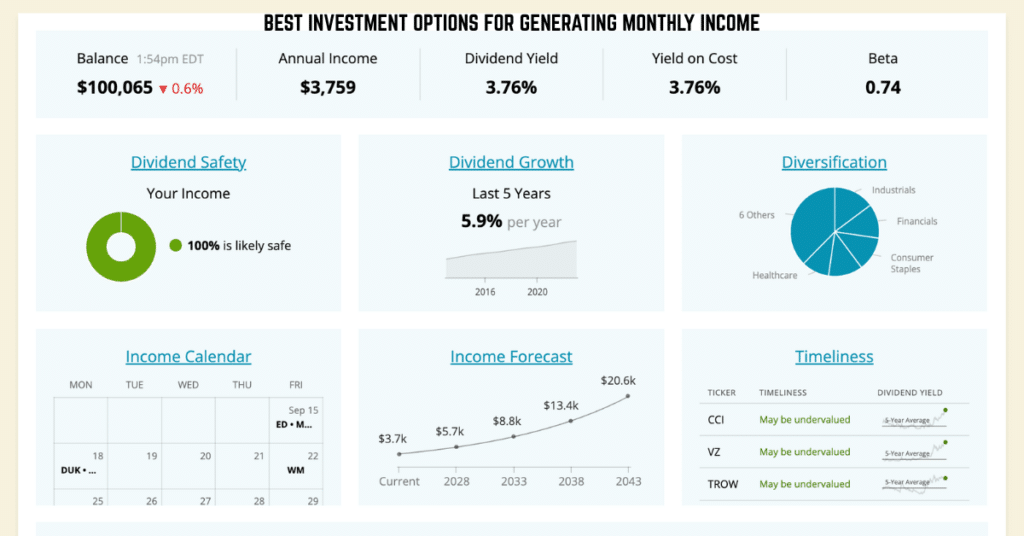
Different investment types serve different purposes in an income-focused portfolio. Understanding how each one works helps you build a diversified approach rather than putting everything into one basket.
Dividend-Paying Stocks represent ownership in companies that regularly share profits with shareholders. Established companies in sectors like utilities, consumer goods, and healthcare often pay dividends quarterly. Dividend yields typically range from 2% to 5% annually for stable companies. The advantage is that dividends can grow over time as companies increase payouts. The risk is that stock prices fluctuate, and companies can reduce or eliminate dividends during difficult periods. Dividend stocks work well for long-term investors who can tolerate price swings while collecting regular payments.
Real Estate Investment Trusts (REITs) own income-producing properties like apartments, shopping centers, and office buildings. By law, REITs must distribute at least 90% of taxable income to shareholders, which often results in yields between 3% and 7%. REITs provide real estate exposure without the hassle of being a landlord. However, REIT prices can be volatile, and they’re sensitive to interest rate changes. They work best as one component of a diversified portfolio rather than a standalone strategy.
Bond Funds and Individual Bonds loan money to governments or corporations in exchange for regular interest payments. Government bonds are extremely safe but currently offer lower yields, often 3-4% for longer-term bonds. Corporate bonds pay more, sometimes 5-6%, but carry default risk. Bond prices fall when interest rates rise, which is important to understand. Bonds provide stability and predictable income, making them essential for conservative investors, but they typically won’t keep pace with inflation over very long periods.
High-Yield Savings Accounts and Certificates of Deposit offer guaranteed returns with no market risk. Current rates fluctuate but have recently been in the 4-5% range. These are perfect for emergency funds and short-term money, but rates can drop when the Federal Reserve lowers interest rates. For someone needing $5,000 monthly from savings accounts alone, you’d need about $1.2-1.5 million, which is safe but offers no growth potential.
Dividend Growth Funds focus on companies with histories of increasing dividend payments over time. These funds typically yield 2-3% initially but can grow dividend income by 5-8% annually. This approach balances current income with future income growth, which helps combat inflation. The trade-off is starting with lower immediate income compared to high-yield options.
Preferred Stocks are hybrid securities that pay fixed dividends like bonds but trade on stock exchanges. Yields often range from 5-7%. They’re less volatile than common stocks but offer no growth potential. Preferred stocks make sense for investors who want higher income than bonds but don’t need capital appreciation.
Business Development Companies (BDCs) lend to or invest in small and mid-sized businesses. They often pay attractive yields of 8-10% or higher. However, they carry significant risk because the underlying businesses may struggle or fail. BDCs should only be a small portion of an income portfolio due to their risk profile.
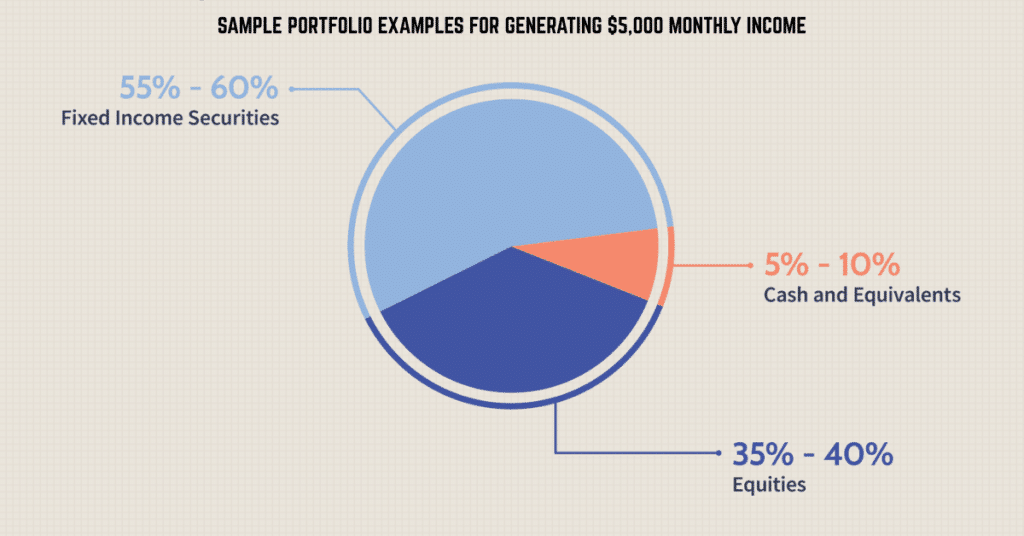
Sample Portfolio Examples for Generating $5,000 Monthly Income
Seeing how different portfolio allocations work in practice helps beginners understand the trade-offs between safety and income.
Conservative Portfolio ($1,500,000 Required for $5,000/Month)
This approach prioritizes capital preservation and income stability, accepting lower returns in exchange for minimal volatility.
- 40% Investment-Grade Bond Funds ($600,000) at 4% = $24,000/year
- 30% Dividend Blue Chip Stocks ($450,000) at 3% = $13,500/year
- 20% REITs ($300,000) at 5% = $15,000/year
- 10% High-Yield Savings ($150,000) at 4.5% = $6,750/year
Total annual income: $59,250 ($4,937/month)
This portfolio works for retirees or anyone who cannot afford to see their principal decline significantly. The heavy bond allocation provides stability, while modest stock and REIT exposure adds some growth potential. The actual monthly income might fluctuate slightly as dividends vary, but it should remain relatively predictable.
Balanced Portfolio ($1,000,000 Required for $5,000/Month)
This middle-ground approach balances income, growth, and risk tolerance for investors with moderate time horizons.
- 25% Total Stock Market Index ($250,000) at 2% dividend = $5,000/year
- 25% Dividend Growth Stocks ($250,000) at 3% = $7,500/year
- 20% REITs ($200,000) at 6% = $12,000/year
- 15% Corporate Bond Fund ($150,000) at 5% = $7,500/year
- 10% Preferred Stocks ($100,000) at 6% = $6,000/year
- 5% BDCs ($50,000) at 9% = $4,500/year
Total annual income: $62,500 ($5,208/month)
This portfolio accepts moderate price fluctuations in exchange for better income and growth potential. The diversification across asset types helps smooth out volatility while maintaining sufficient yield. Over time, the dividend growth component should increase income to keep pace with inflation.
Higher Income Portfolio ($750,000 Required for $5,000/Month)
This aggressive approach maximizes current income but accepts significant volatility and higher risk.
- 35% High-Dividend Stocks ($262,500) at 5% = $13,125/year
- 30% REITs ($225,000) at 7% = $15,750/year
- 15% Preferred Stocks ($112,500) at 6.5% = $7,312/year
- 10% BDCs ($75,000) at 10% = $7,500/year
- 10% Corporate Bonds ($75,000) at 5.5% = $4,125/year
Total annual income: $67,812 ($5,651/month)
This portfolio generates the target income with less capital, but the price swings can be uncomfortable. During market downturns, this portfolio might lose 20-30% of its value, even while continuing to pay dividends. It works best for investors with other income sources who can ride out volatility and won’t need to sell during downturns.
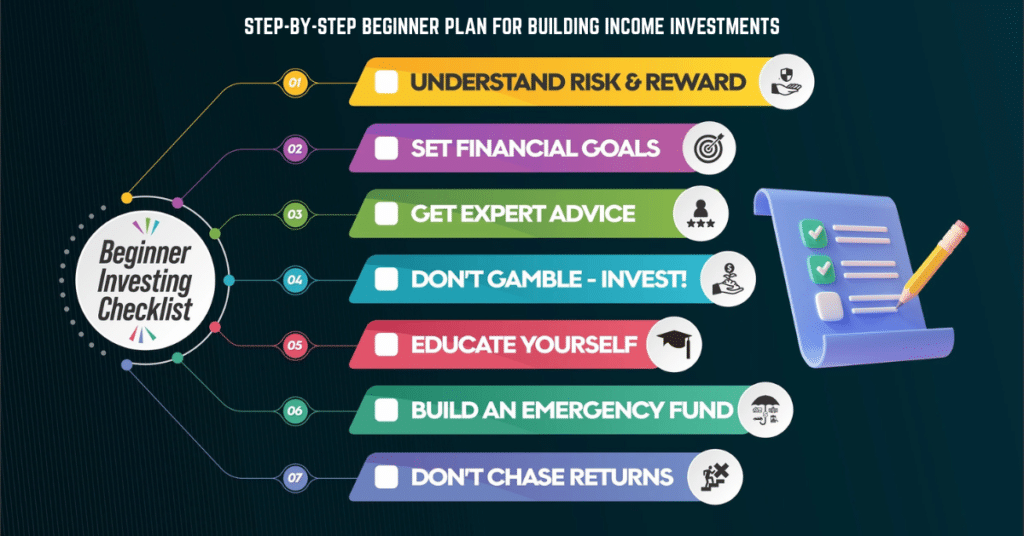
Step-by-Step Beginner Plan for Building Income Investments
Starting from scratch and working toward $5,000 monthly income takes time and deliberate planning. Here’s how beginners can approach this goal realistically.
Step 1: Start with a financial foundation. Before investing for income, establish an emergency fund covering 3-6 months of expenses in a high-yield savings account. Clear high-interest debt like credit cards, since paying 18% interest negates any investment returns. Max out any employer 401(k) match, which provides instant guaranteed returns.
Step 2: Calculate your realistic target. Determine how much capital you can realistically accumulate through savings and investment growth over your timeline. Someone starting with $100,000 and adding $2,000 monthly with 7% average returns would reach $1,000,000 in about 17 years. Adjust expectations based on your starting point and contribution capacity.
Step 3: Build a diversified foundation first. Begin with broad-based index funds that provide growth and modest dividends. This builds wealth faster than starting with high-yield investments that sacrifice growth. A total stock market index fund and a total bond market fund create a solid base.
Step 4: Gradually shift toward income as you approach your goal. When you’re within 5-7 years of needing the income, start transitioning portions of your portfolio toward dividend stocks, REITs, and bonds. This gradual shift prevents the mistake of suddenly moving everything at once, potentially at unfavorable prices.
Step 5: Test your income strategy before relying on it. A year before you need the income, start tracking what your portfolio actually generates monthly. This reveals whether your projections match reality and gives time to adjust if needed. Many beginners discover their yield estimates were too optimistic.
Step 6: Create a withdrawal system. Set up automatic transfers from your brokerage account to your checking account. Many brokers can aggregate dividends and interest into a cash account for easy distribution. Decide whether you’ll reinvest excess income during good years or spend it.
Safe vs High Return Expectations: What’s Realistic?
One of the biggest beginner mistakes is expecting returns that sound reasonable but are actually quite difficult to achieve consistently.
Safe, conservative returns from government bonds and high-grade corporate bonds currently range from 3.5% to 5%. These are reliable and predictable, but they barely outpace inflation, which averages around 3% historically. Safety means your principal is protected, but your purchasing power only grows slowly.
Moderate balanced returns from diversified portfolios of stocks and bonds have historically averaged 6-8% annually over long periods. This includes price appreciation and dividend income. These returns involve accepting year-to-year volatility, with some years delivering 20%+ gains and others showing 10-15% losses. The key word is “average over time.”
Aggressive growth returns of 10-12% annually are possible but require taking significant risk, accepting high volatility, and often involve investing in smaller companies or emerging markets. Very few professional investors consistently achieve 10%+ returns over decades. When someone promises guaranteed returns above 8-10%, it’s often a red flag for fraud.
Unrealistic or dangerous return claims include anything promising 15%+ annually with low risk, guaranteed monthly returns regardless of market conditions, or strategies that sound too good to be true. These are either scams, highly risky speculative ventures, or misleading marketing. The investment world simply doesn’t offer safe, guaranteed high returns because risk and return are fundamentally connected.
For $5,000 monthly income planning, using 5-7% as your expected average return creates a realistic framework. Planning for 10%+ returns often leads to disappointment or excessive risk-taking that backfires during downturns.
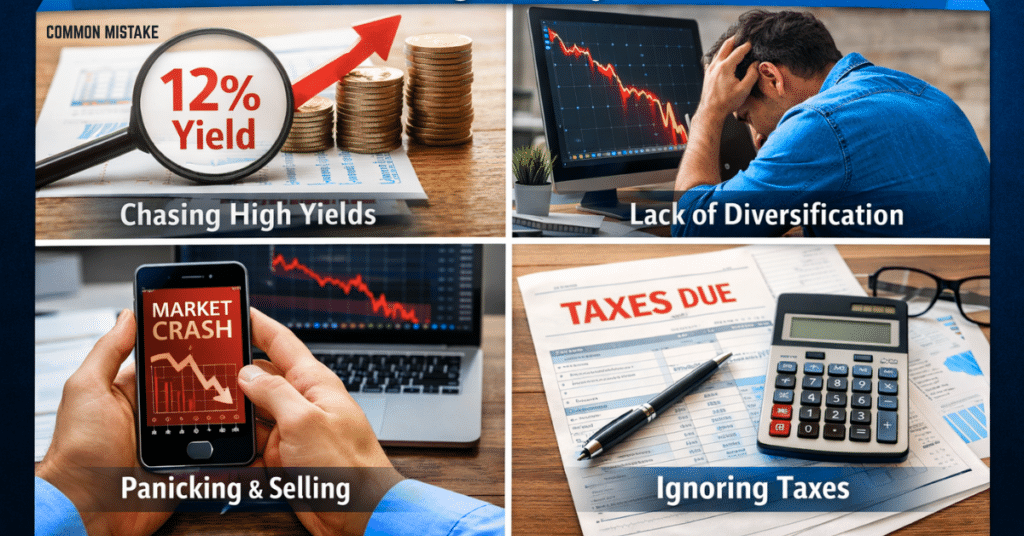
Common Beginner Mistakes When Pursuing Monthly Income
Understanding what goes wrong helps you avoid expensive learning experiences.
Chasing the highest yields without understanding risk. Beginners often see a 12% yield and immediately invest without asking why it’s so high. High yields often signal high risk—the company might cut the dividend, the stock price might collapse, or the investment might be fundamentally unstable. Always investigate what creates a yield and whether it’s sustainable.
Concentrating too heavily in one sector. Putting everything into REITs because they pay well, or only buying oil company stocks for dividends, creates dangerous concentration. When that sector struggles, your entire income stream suffers. Diversification across different investment types and sectors provides protection.
Ignoring taxes on investment income. Dividends and interest are taxable in non-retirement accounts. Depending on your tax bracket and the type of income, you might pay 15-37% in taxes on your earnings. Many beginners calculate $5,000 monthly income but forget they’ll only net $3,500-$4,000 after taxes. Plan accordingly and consider tax-advantaged accounts where possible.
Selling during downturns because prices dropped. Your dividend stocks might fall 20% in value during a market correction, even though they’re still paying dividends. Beginners panic and sell, locking in losses. If the dividend payments continue and the company fundamentals remain strong, price drops can be opportunities to buy more, not reasons to sell.
Underestimating how long building wealth takes. Reaching $1,000,000 to generate $5,000 monthly takes most people 15-30 years of consistent saving and investing. Beginners sometimes expect to reach this goal in 5 years on a moderate salary, which isn’t realistic without an inheritance, business success, or other windfall.
Withdrawing principal when income falls short. If your investments generate $4,000 monthly but you need $5,000, taking $1,000 from principal each month steadily depletes your capital. This downward spiral eventually exhausts your investment base. Either adjust spending, increase capital, or accept lower income than initially hoped.
Practical Safety Tips for Income Investors
Protecting your capital while generating income requires ongoing attention and smart practices.
Reinvest income during accumulation years. Until you actually need the income, reinvest all dividends and interest to buy more shares. This compound growth accelerates wealth building significantly. Someone reinvesting dividends on $500,000 for 10 years at 7% total return ends with substantially more than someone who spent the dividends.
Maintain at least 1-2 years of expenses in cash reserves. Even when living off investment income, keep separate emergency funds. Markets crash, dividends get cut, and unexpected expenses happen. Having cash reserves prevents forced selling during downturns.
Review and rebalance annually. Investment allocations drift over time as some assets grow faster than others. Once yearly, check if your portfolio still matches your target allocation and adjust if needed. This disciplined approach forces you to sell what’s performed well and buy what’s lagged, which is counterintuitive but effective.
Don’t chase past performance. An investment that delivered 15% last year might disappoint this year. Beginners often invest in whatever performed best recently, buying high just before returns normalize. Focus on fundamentals and sustainability rather than backward-looking performance.
Use limit orders and avoid market orders. When buying or selling, set a specific price rather than accepting whatever the market offers. This small habit prevents overpaying or underselling, especially in volatile markets or with less liquid investments.
Stay informed but don’t obsess. Check your portfolio monthly or quarterly, not daily. Constant monitoring leads to emotional reactions and poor decisions. Successful income investing is usually boring—the same holdings paying consistent dividends year after year.
Consider working with a fee-only financial advisor. When your portfolio reaches $250,000-$500,000, professional guidance becomes increasingly valuable. Fee-only advisors charge for advice without selling products, avoiding conflicts of interest. They can help with tax optimization, estate planning, and strategy adjustments.
Frequently Asked Questions
Q1. How long does it take to build enough wealth to generate $5,000 monthly in investment income?
For most people, reaching the $750,000 to $1,500,000 needed takes 15-30 years of consistent saving and investing. Someone starting with $50,000 and contributing $1,500 monthly with 7% average returns would reach $1,000,000 in about 23 years. Higher initial amounts or larger monthly contributions shorten this timeline, while lower returns extend it. The key is starting early and maintaining consistency through market ups and downs.
Q2. Should I focus on dividend stocks or bonds for monthly income?
Neither exclusively—a combination provides better results for most investors. Dividend stocks offer growth potential and inflation protection through rising dividends over time, but they’re volatile. Bonds provide stability and predictable income but limited growth. A balanced approach using both creates more reliable income with reasonable risk. Your exact mix depends on your age, risk tolerance, and when you need the income.
Q3. Can I safely withdraw $5,000 monthly from a $600,000 portfolio?
Withdrawing $5,000 monthly from $600,000 equals a 10% annual withdrawal rate, which is dangerously high for long-term sustainability. Financial planners traditionally recommend 4% withdrawal rates to avoid depleting principal over 30 years. At 10%, you’ll likely exhaust your portfolio within 10-15 years, especially if markets perform poorly early on. Either increase your capital to $1,200,000-$1,500,000 or reduce monthly withdrawals to sustainable levels.
Q4. What happens to my income strategy if interest rates change significantly?
Rising interest rates typically hurt bond prices and REIT values short-term but increase yields on new investments. Falling rates do the opposite. Dividend stocks are less directly affected but can suffer if rate changes indicate economic problems. The solution is diversification—owning various income sources means rate changes help some holdings while hurting others, balancing overall impact. Long-term investors shouldn’t dramatically change strategy based on rate movements.
Q5. Is it better to invest in individual dividend stocks or dividend-focused funds?
For most beginners, dividend-focused ETFs or mutual funds provide better diversification and require less research than picking individual stocks. A single fund might hold 50-100 dividend-paying companies, spreading risk. Individual stocks make sense once you have $300,000+ and time to research companies thoroughly. Many successful income investors use both—funds for core holdings and individual stocks for specific opportunities.
Q6. How do I protect my income investments during a market crash?
Accept that portfolio values will decline during crashes, but focus on whether dividend payments continue. Many quality companies maintained or even increased dividends during the 2008-2009 financial crisis and 2020 pandemic crash, even as stock prices fell 30-50%. Avoid panic selling, maintain cash reserves for emergencies, and consider market drops as opportunities to invest additional capital at lower prices. The investors who sold during crashes missed the subsequent recoveries.
Q7. Should I invest everything at once or gradually over time?
Research shows lump-sum investing usually outperforms dollar-cost averaging because markets trend upward over time. However, many investors feel more comfortable spreading large investments over 6-12 months to reduce the emotional impact of a potential immediate drop. This is more about psychology than optimal returns. For regular monthly investing from income, just invest consistently regardless of market conditions—attempting to time the market typically reduces long-term returns.
Conclusion: Building Your Path to $5,000 Monthly Income
Generating $5,000 in monthly investment income is an achievable goal, but it requires realistic expectations, patience, and disciplined investing. Most people will need between $750,000 and $1,500,000 invested to reach this target sustainably, depending on their risk tolerance and investment approach.
The journey to building this level of wealth takes time—often 15-30 years of consistent contributions and smart portfolio management. Start with a diversified foundation, gradually shift toward income-producing assets as you approach your goal, and avoid the common mistakes of chasing unrealistic yields or panicking during market downturns.
Remember that sustainable income investing balances current yield with capital preservation and future growth. Whether you’re just starting or already building your portfolio, focus on steady progress rather than shortcuts, and consider professional guidance as your wealth grows.
Disclaimer: This article is for informational purposes only and does not constitute financial advice. Investment values fluctuate, and you may lose money. Consult with a qualified financial advisor before making investment decisions based on your personal circumstances, risk tolerance, and financial goals.
