

Introduction
Say you have some money sitting in your checking account — maybe $5,000 or $10,000 — that you know you’ll need in the next 6 to 12 months. You don’t want it just sitting there doing nothing, but you also can’t afford to lose it. This is exactly the situation where understanding which is an example of a short term investment becomes genuinely useful.
Short-term investments aren’t about getting rich quickly. They’re about putting idle money to work safely for a limited period. By the end of this article, you’ll know what counts as a short-term investment, which options are realistic, what the trade-offs look like, and what beginners usually get wrong.
Quick Answer (Featured Snippet): A short-term investment is any financial asset held for 12 months or less with the goal of preserving capital and earning modest returns. Common examples include Treasury bills, high-yield savings accounts, certificates of deposit (CDs), and money market funds. These options prioritize liquidity and safety over high growth.
What “Short Term Investment” Really Means in Everyday Investing
In plain terms, a short-term investment is money you put somewhere safe for a short period — typically under 12 months — with the expectation that you can get it back without losing the principal.
The IRS actually uses this definition too. Any asset sold within a year is taxed as short-term, meaning gains are taxed at your ordinary income rate, not the lower long-term capital gains rate. That’s worth keeping in mind from day one.
Short-term investing is not about speculation. It’s not day trading or buying a stock hoping it jumps 20% next month. It’s closer to parking your money somewhere better than a regular savings account while you wait for whatever comes next — a home purchase, a tax bill, a business expense, or just building up your emergency fund.
People often confuse short-term investing with short-term trading. They’re very different. Trading involves active buying and selling with real risk of loss. Short-term investing focuses on capital preservation first, modest returns second.
How Short Term Investments Work — Real-Life Flow
Here’s how it typically works in practice.
You decide you have $8,000 that you won’t need for six months. Instead of leaving it in a checking account earning almost nothing, you explore short-term investment options. You open a high-yield savings account or buy a 6-month Treasury bill. Your money sits there, earns interest, and when the time is up, you get your principal back plus the interest earned.
The process is usually straightforward:
You identify how long you can leave the money alone. Then you pick an option that matches that timeline. You invest. You wait. You collect.
The critical part is matching the investment to your actual timeline. If you buy a 12-month CD but need the money in 8 months, you’ll likely pay an early withdrawal penalty. That mismatch is one of the most common beginner mistakes.
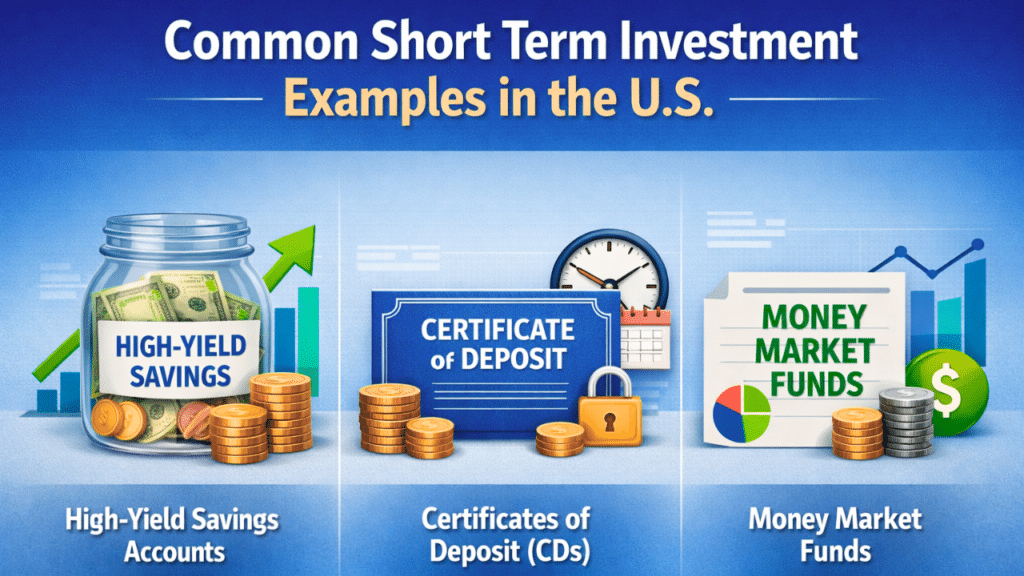
Common Short Term Investment Examples in the U.S.
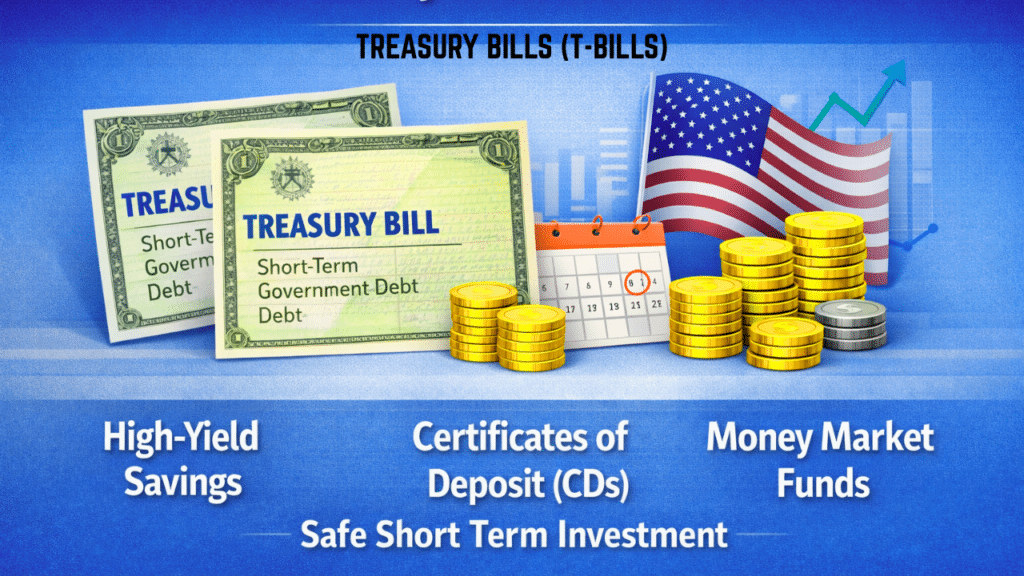
1. Treasury Bills (T-Bills)
Issued by the U.S. government, T-bills are available in terms of 4, 8, 13, 17, 26, and 52 weeks. They’re considered one of the safest investments in the world because they’re backed by the federal government. You buy them at a discount and receive the full face value at maturity. As of recent years, 6-month T-bills have offered yields in the 4–5% range, though rates change with Federal Reserve policy. You can buy them directly at TreasuryDirect.gov with no fees.
2. High-Yield Savings Accounts (HYSAs)
These are regular savings accounts offered mostly by online banks, but with interest rates significantly higher than traditional banks. They’re FDIC-insured up to $250,000, meaning your money is protected even if the bank fails. Rates fluctuate with the market, so they’re not locked in. Good for money you might need to access unexpectedly.
3. Certificates of Deposit (CDs)
A CD is a time deposit at a bank. You agree to leave your money for a fixed period — say 3, 6, or 12 months — in exchange for a guaranteed interest rate. The trade-off is liquidity: pull the money early and you usually forfeit some interest. CDs are also FDIC-insured, which makes them low-risk. If you’re certain about your timeline, they can offer slightly better rates than HYSAs.
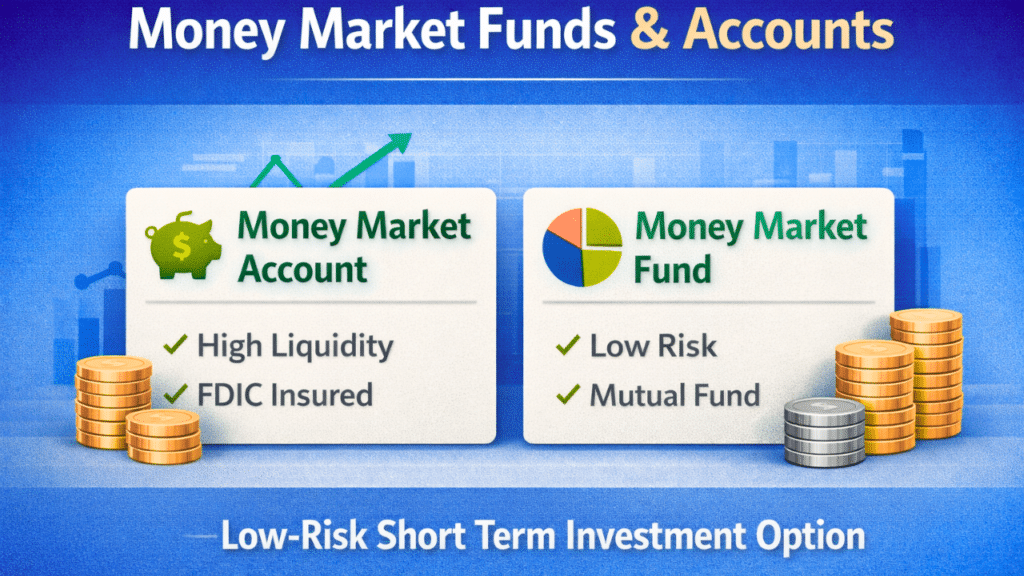
4. Money Market Funds
These are mutual funds that invest in very short-term, low-risk debt instruments. They’re not FDIC-insured like bank accounts, but they’re considered very stable. Available through most brokerages, they’re useful if you already have an investment account and want to park cash temporarily. Yields are generally competitive with HYSAs.
5. Short-Term Bond Funds
These invest in bonds maturing in 1–3 years. They carry slightly more risk than the options above because their value can fluctuate, but they also offer somewhat higher potential returns. These are better for investors comfortable with minor short-term value changes.
Pros and Cons — Honest and Balanced
| Feature | Pros | Cons |
| Safety | Most options are FDIC-insured or government-backed | Returns are modest — rarely beating inflation significantly |
| Liquidity | HYSAs and T-bills are relatively easy to access | CDs can lock your money in |
| Returns | 4–5% is realistic in the current rate environment | Rates can drop; returns aren’t guaranteed long-term |
| Taxes | Straightforward | Interest is usually taxed as ordinary income by the IRS |
| Simplicity | Easy to open and manage | Requires matching timeline carefully to avoid penalties |
A Realistic Example With Simple Numbers
Suppose you have $5,000 that you won’t need for six months.
Option A — High-Yield Savings Account at 4.5% APY: $5,000 × 4.5% ÷ 2 (for 6 months) = approximately $112.50 in interest.
Option B — 6-Month Treasury Bill at 5.0%: $5,000 × 5.0% ÷ 2 = approximately $125.00 in interest.
Neither amount is life-changing, but it’s money you wouldn’t have earned otherwise — and your $5,000 is still intact at the end. That’s the point. You’re not trying to double your money. You’re making sure it works while you wait.
One thing to note: the $112–$125 you earn will be reported to the IRS and taxed as ordinary income. If you’re in the 22% tax bracket, your after-tax gain drops to roughly $87–$97. Still better than nothing, but worth factoring in.
Common Mistakes Beginners Make
Chasing the highest yield without checking liquidity. Some people lock into a 12-month CD because it offers 0.25% more than a 6-month option, then need the money at month 8 and pay a penalty that wipes out the extra earnings.
Thinking stocks are a short-term investment. Stocks can lose 20–30% of their value in a matter of months. If you need that money back soon, stocks are not appropriate — no matter how confident you feel about a specific company.
Ignoring taxes. Many beginners calculate their expected return without factoring in federal (and sometimes state) income taxes on interest earned. The net return is what matters.
Leaving money in a regular checking account. Traditional banks often pay 0.01% interest. Moving to even a basic HYSA can earn 400–500 times more on the same balance, with the same FDIC protection.
Over-complicating it. Some beginners research dozens of options, get overwhelmed, and do nothing. For most people, a high-yield savings account or T-bill is a perfectly reasonable starting point.
Practical Tips to Use Short Term Investments Safely
Match the investment term to your actual need date. If you need money by March, don’t buy an investment that matures in June.
Keep your emergency fund separate. Your emergency fund should stay in something immediately accessible — like a HYSA — not tied up in a CD.
Don’t put money you might need early into a CD without understanding the penalty structure. Always read the early withdrawal terms before committing.
Use TreasuryDirect.gov for T-bills if you want a simple, fee-free, government-backed option. It’s less convenient than a brokerage but reliable.
Diversify across options if you have a larger amount. For example, put half in a HYSA for liquidity and half in a T-bill for a slightly better rate.
According to NerdWallet, high-yield savings accounts are one of the most practical short term investment examples for beginners because of their simplicity and FDIC protection. Investopedia similarly notes that T-bills are widely used as a benchmark for risk-free short-term returns in the U.S.
Frequently Asked Questions
Q1. What is the safest short term investment?
Treasury bills are generally considered the safest because they’re backed by the U.S. government. High-yield savings accounts insured by the FDIC are a close second for everyday consumers. Neither carries meaningful risk of losing your principal.
Q2. Is a stock ever considered a short term investment?
Technically, any asset held for under a year is classified as short-term for IRS purposes. But in practice, stocks are volatile and inappropriate for money you need to preserve over a short period. Holding a stock for 6 months doesn’t make it a safe short-term asset — it just means gains are taxed as short-term capital gains.
Q3. Which investment is best for 3 months?
For a 3-month window, a high-yield savings account or a 13-week Treasury bill are the most practical options. CDs can work too if you find one with a 3-month term and no early withdrawal penalty.
Q4. Are short term investments taxable?
Yes. Interest earned from HYSAs, CDs, and T-bills is generally taxable as ordinary income at the federal level. T-bill interest is exempt from state and local taxes, which can be a mild advantage depending on where you live. Always check with a tax professional for your specific situation.
Q5. What is considered short term in investing?
The IRS defines short-term as any asset held for 12 months or less. In general financial planning, short-term investing usually refers to a time horizon of anywhere from one month to about two years.
Q6. What is the difference between a money market account and a money market fund?
A money market account is a bank product — FDIC-insured and similar to a savings account. A money market fund is a mutual fund product offered through brokerages — not FDIC-insured, though considered very low-risk. Both can serve as short-term assets, but they work differently and carry different protections.
Q7. Can I lose money in short term investments?
With FDIC-insured products like HYSAs and CDs, losing your principal is very unlikely within the $250,000 coverage limit. With money market funds or short-term bond funds, there’s a small but real possibility of minor value fluctuations. Treasury bills carry essentially zero default risk. No investment is technically zero-risk, but these options sit at the low end of the risk spectrum.
Conclusion
Short-term investing is one of the more practical, low-stress areas of personal finance once you understand what it actually involves. It’s not about big returns or market predictions. It’s about using the time your money would otherwise sit idle to earn something modest while keeping it safe and accessible.
If you’re holding cash for a few months and wondering where to put it, you now have a clear picture of your options — from Treasury bills to high-yield savings accounts to CDs. Each has trade-offs, and the right choice depends on your timeline, your tax situation, and how much flexibility you need.
You don’t need to optimize every dollar. You just need to make a reasonable choice that fits your actual situation.
Disclaimer: This article is for informational purposes only and does not constitute financial advice. Consult a licensed financial professional before making investment decisions.
