
Introduction
The commercial savings bank is a very critical institution in assisting business to efficiently, safely and profitably manage money. No matter if you are a startup, a mid-sized company, or a large enterprise, the appropriate bank will help simplify your finances, secure your money and promote expansion. Here, you will discover all about commercial savings banks and in this guide you will be informed of what, how, and benefits, costs, and how to select the right commercial savings bank to fit your business.
What Is a Commercial Savings Bank?
The commercial savings bank is a financial institution, which provides savings accounts, lending services, cash management products, and business and corporate financial services. They are the banks that assist companies to deposit funds, get an interest, borrow money, and handle their financial activities effectively.
They do not match general retail banks because their products suit the business requirements, such as high volume transactions, superior security, and sophisticated banking features.

Importance of Commercial Savings Banks
The reason why commercial savings banks are important is that they:
- Offer safe areas where companies can save money.
- Get companies to make interest on the idle money.
- Give credit, loans and line of credit to spur growth.
- Eliminate credit risks through fraud protection and insurance.
- Enhance the ease of management of cash flows, payroll, and vendor payments.
- Provide business-related financial services and financial planners.
In the USA, UK, Italy, Germany, and other countries with high CPC, commercial banking is the support of the financial sustainability and growth.
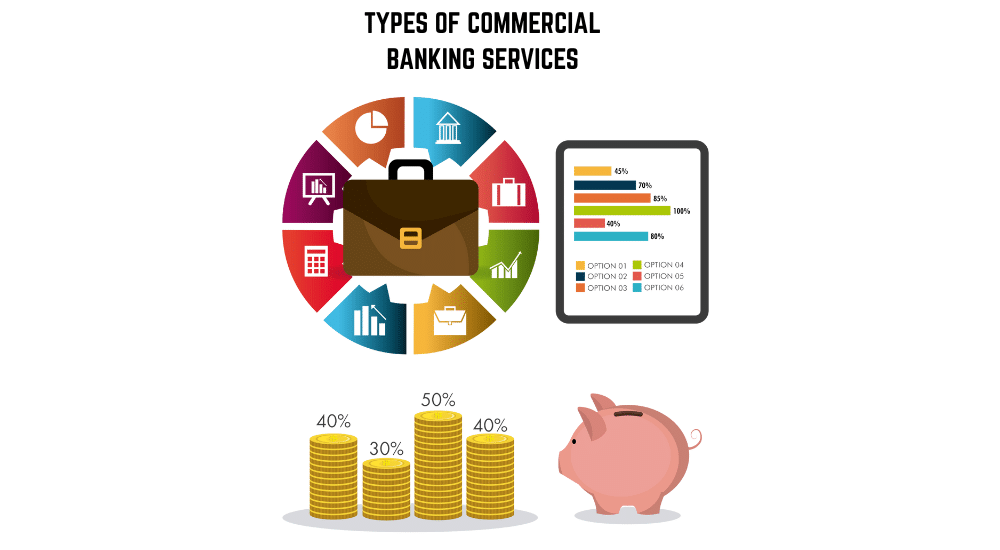
Types of Commercial Savings Bank Services
1. Business Savings Accounts
Banks provide savings accounts that are highly yielding and businesses maintain their funds in these accounts where they can earn interest whilst having the money readily available.
2. Business Checking Accounts
Created to make day-to-day transactions, to pay vendors, to payroll and to control expenses.
3. Commercial Loans
Includes:
- Term loans
- Equipment financing
- Inventory financing
4. Lines of Credit
Operating cost and cash flow financings or expansion needs.
5. Merchant & Payment Services
Receive credit cards, online payments and process customer transactions.
6. Treasury & Cash Management
In the case of large businesses that need sophisticated cash-flow instruments.
7. International Business Banking.
Accepts international payments, foreign bank accounts, and international transfers.
Step-by-Step Process to Open an Account
- Choose the right bank
Compare prices, interest rates and services. - Gather business documents
EIN/Tax ID
Business registration
Operating agreement
Proof of identity56 - Submit the application
Online or in-branch. - Deposit the minimum funds
Normally between 50 and 500 basing on the bank. - Set up online banking & tools
Mobile banking
Payment gateways
Alerts & security options - Begin managing business finances.
Trace transactions, automate payment, and cash flow.
Costs of Using a Commercial Savings Bank
| Cost Type | Average Amount | Notes |
| Monthly maintenance charge | $10-50 | Certain banks do not charge with minimum deposit. |
| Minimum balance | $500-5,000 | Depends on the bank and type of account. |
| Transaction charges | 0.25-1 per additional transaction | Beyond free threshold |
| Wire transfer | $10- 45 | Nationally and globally. |
| Overdraft charges | 25-40 | Goes against account. |
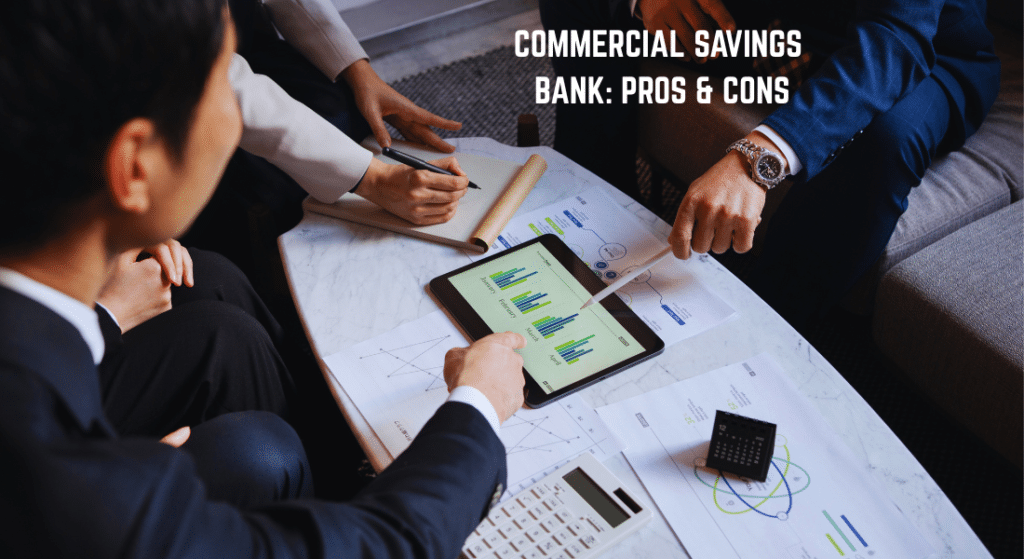
Pros & Cons Table
| Pros | Cons |
| Savings are secure and insured | Certain accounts are highly minimum. |
| Loans and credit | Interest is expensive. |
| Tools that are business oriented | Business paperwork is needed. |
| Interest on deposits | Interest rates are subject to change. |
| Professional financial advice | Lack of flexibility as compared to fintech. |
Comparison Chart – Commercial Bank vs Retail Bank
| Feature | Commercial Savings Bank | Retail Bank |
| Targeted at | Businesses | Individuals. |
| Loan types | Commercial loans, credit lines, Personal loans. | |
| Cash-management tools | High-level | Low-level. |
| Transaction limits | Greater | Reduced. |
| Interest on savings | Quite often greater | Standard. |
| Fees | Higher | Lower |
Common Mistakes to Avoid
- Selecting a bank based on the low costs alone and not its value in the long run.
- Failure to keep minimum balance requirements.
- Treating fraud-prevention tools as noise.
- Commingling business and personal finances.
- Inability to bargain over interest rates or loan conditions.
- Not a a comparison of several banks and then picking up.
Expert Tips
- Always keep business and personal accounts separate.
- Choose a bank with strong digital tools, especially for international business.
- Negotiate fees—many banks offer waivers.
- Pick a bank offering 24/7 support if you operate in multiple countries.
- Use automated savings tools to maximize interest growth.
FAQs
Q1. What is a commercial savings bank?
A commercial savings bank refers to a financial institution that provides businesses with savings, loans and other financial services.
Q2. Should small business get a commercial savings bank?
Yes. It offers superior cash management, credit facilities and financial security.
Q3. Would it be possible to open a commercial account online?
Majority of banks have online applications but some might need to visit the bank physically to get the application verified.
Q4. What documents do I need?
Registration of the business, EIN/Tax ID, ID proof and operating agreement.
Q5. Are commercial savings accounts interest bearing?
Yes, the majority of them have interest on their accounts- some have a higher rate on the bigger deposit.
Q6. Are there increased fees on the commercial banks?
Usually yes, as they present superior tools and increased transaction limit.
Q7. Are startups able to open commercial accounts?
Absolutely. Startups enjoy good financial structuring at an initial stage.
Conclusion
Business finances require the handling of a commercial savings bank as a way of earning interest, securing and getting credit opportunities. You have either a startup, a developing business or a multinational corporation, but selecting the appropriate bank can change your finances.
