
If you’ve filled out the FAFSA and seen “Direct Unsubsidized Loan” listed in your financial aid offer, you’re probably wondering what makes it different from other federal loans — and why the interest seems to start adding up before you’ve even graduated.
Here’s the short answer: a Direct Unsubsidized Loan is a federal student loan that isn’t based on financial need, and unlike a subsidized loan, interest begins accruing from the day it’s disbursed — including while you’re still in school. That interest doesn’t disappear. If it isn’t paid, it typically gets added to your balance later, which means you can end up owing more than you originally borrowed.
This article walks through how unsubsidized loans work, who qualifies, current borrowing limits, how the interest actually adds up over time, when repayment starts, and how to keep the total cost as low as possible. The goal isn’t to tell you whether to borrow — it’s to help you understand exactly what you’re agreeing to before you sign a Master Promissory Note.
Asad is a Personal Finance & Student Finance Writer focused on making complex financial topics easier to understand. His work covers student loans, banking, insurance, investing, and everyday money management, with an emphasis on clear, practical, and research-based financial education for U.S. readers. He uses reliable sources and official financial information to help readers better understand their options and make informed financial decisions.
What Is an Unsubsidized Student Loan?
A Direct Unsubsidized Loan is one of the two main types of federal loans offered through the Direct Loan Program (the other being the Direct Subsidized Loan). Both are issued by the U.S. Department of Education, but they work differently in one important respect: eligibility for a subsidized loan depends on demonstrated financial need, while an unsubsidized loan does not. Any student who meets the general federal aid requirements can be offered one, regardless of household income.
The word “unsubsidized” refers to who pays the interest, not whether the loan itself is a bad deal. With a subsidized loan, the federal government covers the interest during certain periods — mainly while you’re enrolled at least half-time and during your grace period. With an unsubsidized loan, you are responsible for all of the interest, from the first disbursement onward, whether or not you’re in school.
Both undergraduate and graduate or professional students can receive Direct Unsubsidized Loans. Subsidized loans, by contrast, are only available to undergraduates who demonstrate financial need.
How Do Unsubsidized Student Loans Work?
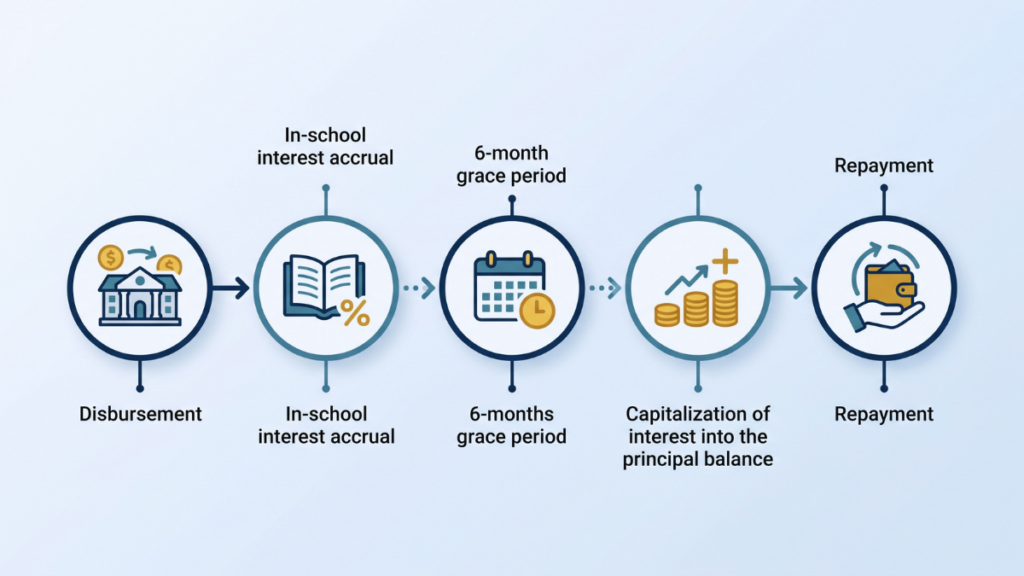
The mechanics are fairly straightforward once you separate the loan into a few stages:
Disbursement. Your school receives the loan funds directly, usually split across terms (for example, half in the fall and half in the spring), and applies them to tuition, fees, and other school charges. Any leftover amount is refunded to you for other education expenses.
Interest accrual. Interest on a Direct Unsubsidized Loan starts building from the moment the first disbursement is made. This is true even while you’re actively enrolled and even during your grace period after leaving school — periods when a subsidized loan would not be accruing interest for you.
In-school period. You are not required to make payments while you’re enrolled at least half-time, but the interest keeps accumulating in the background whether you pay it or not.
Grace period. After you graduate, drop below half-time enrollment, or withdraw, you generally get a six-month grace period before required payments begin. Interest continues to accrue during this window.
Capitalization. If you don’t pay the interest as it accrues, it’s typically added to your principal balance at certain points — often when the loan enters repayment. Once that happens, future interest is calculated on the new, larger balance. This is the single biggest reason unsubsidized loans can end up costing more than the sticker amount suggests.
Repayment. Once your grace period ends, you begin making scheduled payments under whichever repayment plan you’ve selected or been assigned.
Who Is Eligible for an Unsubsidized Student Loan?
Eligibility is broader than for subsidized loans because financial need isn’t a factor. Generally, to receive a Direct Unsubsidized Loan you need to:
- Be a U.S. citizen or eligible noncitizen
- Be enrolled at least half-time in an eligible degree or certificate program at a participating school
- File the FAFSA and meet standard federal student aid requirements (not be in default on an existing federal loan, maintain satisfactory academic progress, and so on)
- Have your school confirm enrollment and calculate your eligible loan amount based on your cost of attendance and other aid
Both undergraduate students and graduate or professional students can qualify. This is a key structural difference from subsidized loans, which are undergraduate-only. Because graduate and professional students are considered independent for federal aid purposes, they typically rely on unsubsidized loans as their primary (and, as of mid-2026, largest) source of federal borrowing.
Your school’s financial aid office ultimately determines your specific eligible amount within the federal limits, based on your remaining cost of attendance after other aid is applied.
How Much Can You Borrow With an Unsubsidized Student Loan?
Borrowing limits depend on your grade level, dependency status, and — for graduate and professional students — the type of program, and these figures have changed for loans first disbursed on or after July 1, 2026, under new federal rules.
Undergraduate students continue to have combined annual limits (subsidized plus unsubsidized together) that scale with year in school — generally $5,500 for first-year students, $6,500 for second-year students, and $7,500 for third-year and beyond, with dependent students eligible for somewhat less than independent students in some years. Aggregate undergraduate limits are $31,000 for dependent students (no more than $23,000 of which can be subsidized) and $57,500 for independent undergraduates and certain dependent students whose parents cannot obtain a PLUS loan (again, capped at $23,000 subsidized).
Graduate and professional students saw a significant structural change starting July 1, 2026. Direct Unsubsidized Loans are now capped at $20,500 per year with a $100,000 lifetime limit for most graduate programs, and $50,000 per year with a $200,000 lifetime limit for a defined list of professional degree programs (such as law and medicine). There is also a $257,500 aggregate lifetime cap across all federal student loans for a single borrower. This matters because the Grad PLUS Loan program — which previously let graduate and professional students borrow up to their full cost of attendance — was eliminated for new borrowers as of July 1, 2026, under the One Big Beautiful Bill Act (OBBBA). Students who already had a Grad PLUS Loan disbursed before that date may be able to continue borrowing under the old terms for a limited transition period; everyone else now borrows within the new unsubsidized caps and may need to look at other funding sources for any remaining gap.
Because these limits can change from year to year and because your specific eligibility depends on your program and dependency status, always confirm your current limit with your school’s financial aid office or at StudentAid.gov before assuming a number applies to you.
Unsubsidized vs. Subsidized Student Loans
| Feature | Subsidized | Unsubsidized |
|---|---|---|
| Financial need required | Yes | No |
| Available to undergraduates | Yes | Yes |
| Available to graduate/professional students | No | Yes |
| Interest while enrolled at least half-time | Government-paid | Borrower’s responsibility |
| Interest during the grace period | Government-paid | Borrower’s responsibility |
| Interest during deferment | Often government-paid | Borrower’s responsibility |
The distinction really comes down to one sentence: with a Direct Unsubsidized Loan, you are responsible for the interest during every period of the loan’s life, including while you’re in school. With a Direct Subsidized Loan, the government covers interest during qualifying periods, which keeps the balance from growing before you’ve started earning an income.
Because subsidized loans cost less over time and are only available to undergraduates with demonstrated need, the Department of Education’s general guidance is to use subsidized eligibility first, then turn to unsubsidized borrowing to cover any remaining gap — since unsubsidized loans, while more broadly available, carry the interest responsibility from day one.
How Much Interest Does an Unsubsidized Student Loan Accumulate?
For Direct Loans first disbursed between July 1, 2026, and June 30, 2027, the fixed interest rate is 6.52% for undergraduate Direct Unsubsidized Loans (the same rate that applies to undergraduate Direct Subsidized Loans) and 8.07% for Direct Unsubsidized Loans made to graduate and professional students. These rates are fixed for the life of the loan, but a new rate is set each year for loans first disbursed during that 12-month period — so a loan taken out in a different year could carry a different rate. Rates for 2025–26 disbursements, by comparison, were 6.39% for undergraduates and 7.94% for graduate borrowers.
There’s also an origination fee. For loans first disbursed between October 1, 2025, and October 1, 2026, the fee is 1.057% of the loan amount, deducted before the funds reach your school. You still owe the full amount you borrowed, not just what was disbursed after the fee.
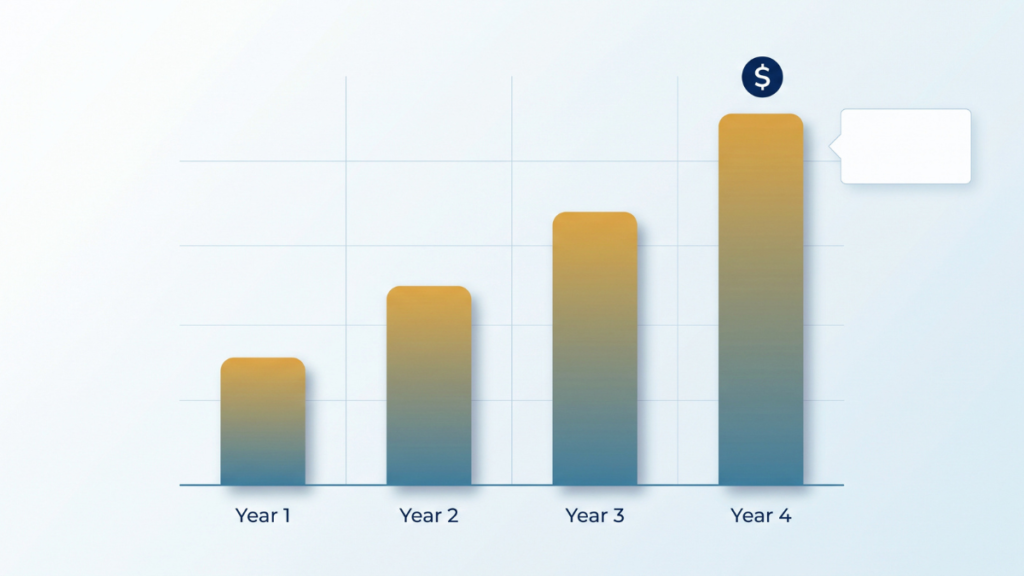
Here’s a simplified, hypothetical example to illustrate how interest builds during school. Suppose a student takes out a $10,000 undergraduate Direct Unsubsidized Loan at the 6.52% rate, and doesn’t make any interest payments during four years of school:
- Daily interest accrual is calculated as: (Principal × Interest Rate) ÷ 365
- On a $10,000 balance at 6.52%: ($10,000 × 0.0652) ÷ 365 ≈ $1.79 per day
- Over one year (365 days) with no payments: roughly $652 in accrued interest
- Over four years, assuming the balance stays at $10,000 with no additional disbursements or payments: roughly $2,608 in accumulated interest
If none of that interest is paid along the way, it will typically be capitalized — added to the principal — when the loan enters repayment. At that point, the loan balance would be closer to $12,608, and future interest would be calculated on that larger amount rather than the original $10,000. This example is illustrative only; it assumes a single lump-sum disbursement and a constant rate, which doesn’t reflect how loans are usually disbursed in installments across a multi-year borrowing history. It’s meant to show the mechanism, not to predict any individual borrower’s actual balance.
When Do You Have to Repay an Unsubsidized Student Loan?
Repayment generally begins after your six-month grace period ends — typically triggered by graduating, dropping below half-time enrollment, or withdrawing from school. Interest keeps accruing throughout this grace period, and if unpaid, it’s usually capitalized once you enter repayment.
Federal repayment rules have been changing substantially. Under the OBBBA, several income-driven repayment plans are being phased out for new borrowers and replaced with a narrower set of options, including a new Repayment Assistance Plan (RAP), alongside a revised Standard Repayment Plan. Which repayment plans you’re eligible for can depend on when your loan was first disbursed and what type of loan it is, and the Department of Education has indicated that transition rules will continue to be finalized through 2026 and beyond. Because this is an area that is actively changing, don’t rely on older articles (including general information here) for your specific options — confirm current repayment plan availability and terms directly at StudentAid.gov or with your loan servicer before choosing a plan.
How to Reduce Interest on an Unsubsidized Student Loan
A few practical habits can meaningfully lower the total interest you pay over the life of the loan:
- Borrow only what you need. Just because you’re eligible for the full annual limit doesn’t mean you have to accept it. Every dollar you don’t borrow is a dollar that never accrues interest.
- Consider paying interest while in school, if you’re able to. Even small, regular payments toward accruing interest prevent that interest from capitalizing later, which keeps your principal from growing before repayment starts.
- Understand capitalization triggers. Interest is commonly capitalized when a loan enters repayment, at the end of a deferment or forbearance, or if you leave an income-driven plan. Knowing when capitalization happens lets you plan around it.
- Make payments when they’re required, and on time. Missed or late payments can add fees and, in some cases, affect your credit and eligibility for certain federal benefits.
- Compare repayment options carefully. Some plans lower your monthly payment but extend the loan term, which can increase total interest paid over time. A shorter term with a higher payment often costs less overall, if your budget allows it.
Are Unsubsidized Student Loans Worth It?
There isn’t a single answer that applies to every borrower. An unsubsidized loan can be a reasonable, and sometimes necessary, way to cover education costs that grants, scholarships, savings, and subsidized aid don’t fully address — particularly for graduate and professional students, who don’t have access to subsidized loans and, since mid-2026, no longer have Grad PLUS Loans as a source of unlimited borrowing up to their cost of attendance.
At the same time, because interest accrues from day one and can capitalize if unpaid, an unsubsidized loan generally costs more over its lifetime than an equivalent subsidized loan, and the gap widens the longer you go without making any interest payments. Before accepting the full amount offered, it’s worth comparing your total expected borrowing against your program’s likely starting salary range, weighing whether scholarships, employer tuition assistance, part-time work, or savings could reduce how much you need to borrow, and reviewing the specific interest rate and origination fee that apply to your loan’s first disbursement date, since these change annually.
For students with financial need, borrowing available subsidized amounts first, then filling any remaining gap with unsubsidized loans, is typically the lower-cost sequence — since subsidized interest coverage during school and the grace period isn’t available on the unsubsidized portion.
Frequently Asked Questions
Q.1 What is an unsubsidized student loan?
It’s a federal Direct Loan available to undergraduate, graduate, and professional students regardless of financial need. The borrower is responsible for all interest that accrues, including while enrolled in school and during the grace period.
Q.2 Does an unsubsidized loan accrue interest while in school?
Yes. Interest begins accruing from the first disbursement date, even while you’re enrolled at least half-time. If you don’t pay it as it accrues, it’s generally added to your principal balance later.
Q.3 What is the difference between subsidized and unsubsidized loans?
Subsidized loans require demonstrated financial need and are only available to undergraduates, with the government covering interest during school and the grace period. Unsubsidized loans don’t require financial need, are available to undergraduate and graduate/professional students, and the borrower is responsible for interest during every period.
Q.4 Who qualifies for an unsubsidized student loan?
U.S. citizens and eligible noncitizens who are enrolled at least half-time in an eligible program, have filed the FAFSA, and meet standard federal aid requirements. Financial need is not a factor, unlike with subsidized loans.
Q.5 When does an unsubsidized loan have to be repaid?
Generally, repayment begins after a six-month grace period following graduation, dropping below half-time enrollment, or withdrawal. Interest continues to accrue during the grace period and is often capitalized when repayment begins.
Q.6 Can you pay an unsubsidized student loan early?
Yes. Federal Direct Loans, including unsubsidized loans, can be paid off in full or in part at any time without a prepayment penalty. Paying extra toward the principal, or paying accrued interest while in school, reduces the total interest you’ll pay over the life of the loan.
Key Takeaways
An unsubsidized student loan gives you access to federal borrowing regardless of financial need, but that access comes with a real cost: you own the interest from the first disbursement, through school, through your grace period, and into repayment. Left unpaid, that interest doesn’t just sit there — it typically gets folded into your principal, increasing what you owe going forward. Borrowing limits, interest rates, and repayment plan options have all shifted meaningfully for 2026–27, particularly for graduate and professional students following the elimination of Grad PLUS Loans, so it’s worth checking your current numbers directly at StudentAid.gov rather than relying on a prior year’s figures. The most reliable way to keep the total cost manageable is straightforward, if not always easy: borrow only what you actually need, and pay down interest along the way whenever your budget allows it.
Author Bio
Asad is a Personal Finance & Student Finance Writer focused on making complex financial topics easier to understand. His work covers student loans, banking, insurance, investing, and everyday money management, with an emphasis on clear, practical, and research-based financial education for U.S. readers. He uses reliable sources and official financial information to help readers better understand their options and make informed financial decisions.