
Most people who ask about the foundation of personal finance already sense that something in their money habits is out of order. Maybe the paycheck disappears before the next one arrives. Maybe there’s no real answer to “where did that money go?” That uncertainty is usually the first sign that a financial foundation hasn’t been built yet — not a lack of income, and not a lack of discipline.
If you’re wondering what is the first foundation in personal finance, the answer is this: knowing exactly where your money goes and creating a plan for it — in other words, financial awareness paired with a working budget. Everything else in personal finance, from emergency savings to investing to paying down debt strategically, is built on top of that single starting point. Without it, even a high income tends to produce financial stress rather than financial stability.
This guide walks through why that foundation matters, how to build it in practical terms, and what typically comes next once it’s in place.
About the Author Asad is a personal finance writer focused on practical money management, budgeting, saving, debt awareness, and financial education. His work is designed to make complex financial concepts easier to understand and apply in everyday life. Asad is a financial content writer, not a licensed financial advisor, and this article should be read as educational content rather than individualized advice.
A Note on This Article
This article is intended as general financial education, not individualized financial advice. Personal finance decisions depend on your income, obligations, goals, and risk tolerance, and this guide should be read with that in mind.
Why This Foundation Matters
A financial foundation works the same way a physical foundation works for a house. You can hang nice fixtures — a retirement account, a brokerage account, a rewards credit card — on a shaky base, but the structure will still be unstable. Budgeting and awareness matter first because every other financial decision depends on accurate information: How much can you actually save? How much debt can you safely take on? How large does an emergency fund need to be for your situation?
Without that information, financial decisions become guesses. With it, they become choices you can defend.
There’s also a behavioral reason this comes first. The Consumer Financial Protection Bureau, a federal agency that oversees consumer financial protection, has published research showing that unexpected expenses — not necessarily low income — are among the most common reasons households struggle to pay their bills. A household that tracks its spending and has a plan is far better positioned to absorb a surprise expense than one that doesn’t, regardless of how much that household earns.
How the First Foundation Works
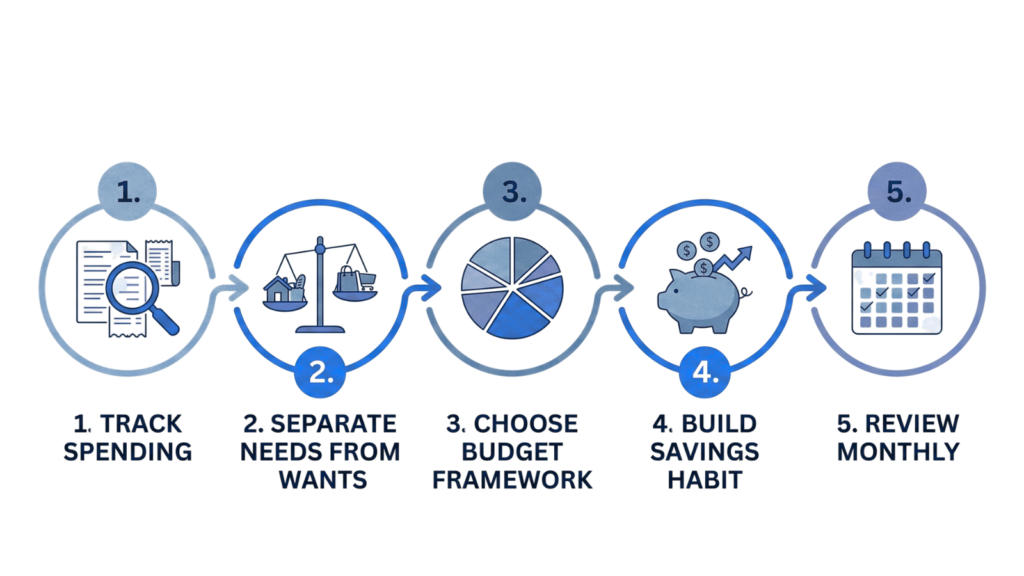
Building this foundation isn’t a single action — it’s a short sequence of habits that reinforce each other.
1. Track where your money actually goes. Before you can budget, you need real numbers, not estimates. Most people underestimate discretionary spending — dining out, subscriptions, small recurring charges — by a significant margin until they track it for a full month. This can be done with a spreadsheet, a banking app’s built-in categorization tools, or a simple notebook. The method matters less than the accuracy.
2. Separate needs from wants. Housing, utilities, groceries, minimum debt payments, and insurance are needs. Streaming services, dining out, and upgraded electronics are wants. This distinction becomes the backbone of any workable budget, because it tells you where flexibility actually exists.
3. Choose a budgeting structure. A widely used starting framework, often associated with Senator Elizabeth Warren’s writing on household finance, allocates roughly 50% of after-tax income to needs, 30% to wants, and 20% to savings and debt repayment beyond the minimum. This 50/30/20 split isn’t a legal or regulatory standard — it’s a rule of thumb, and many households adjust the percentages based on cost of living, income level, or existing debt. In high-cost-of-living areas, needs frequently exceed 50%, which simply means the wants and savings categories need to flex accordingly.
4. Build in a savings habit from the start, even a small one. This is the bridge between the first foundation and the second — typically an emergency fund.
5. Review and adjust monthly. A budget built once and never revisited stops reflecting reality within a few months, as income, rent, and expenses shift.
Important Factors Readers Should Understand
This foundation is behavioral before it’s mathematical. The math of a budget is simple arithmetic. What makes it difficult in practice is consistency — checking in regularly, adjusting for months with irregular expenses, and resisting the urge to abandon the process after a bad month.
Awareness has to come before optimization. People sometimes want to jump straight to advanced strategies — index fund investing, credit card rewards optimization, tax-advantaged accounts — before they’ve established basic spending awareness. Those strategies still work, but they perform far better layered on top of a stable foundation than substituted for one.
“Budgeting” doesn’t mean restriction. A common misconception is that budgeting means cutting out everything enjoyable. In practice, a good budget is simply a decision made in advance about where money will go, which includes deliberately funding things you value — travel, hobbies, dining out — rather than spending on them by default and feeling guilty afterward.
Debt changes the order of operations somewhat. If you’re carrying high-interest debt, particularly credit card debt, the first-foundation stage typically includes assessing that debt honestly as part of your budget, since it directly affects how much you can realistically allocate to savings. As of 2026, the average interest rate on credit card accounts that carry a balance has remained above 20% APR according to Federal Reserve consumer credit data, which means the “cost” of not addressing high-interest debt tends to outweigh the benefit of many other financial moves you could make first.
A Realistic Example
Consider a hypothetical single earner, Maria, who brings home $4,200 per month after taxes. Before tracking her spending, she assumed she was “doing fine” because she wasn’t overdrawing her checking account. After one month of tracking every transaction, she found the following:
- Rent and utilities: $1,500
- Groceries and household essentials: $450
- Minimum debt payments: $300
- Transportation: $250
- Insurance: $150
- Subscriptions, dining out, and discretionary spending: $1,100
- Savings: roughly $450 left over, saved inconsistently
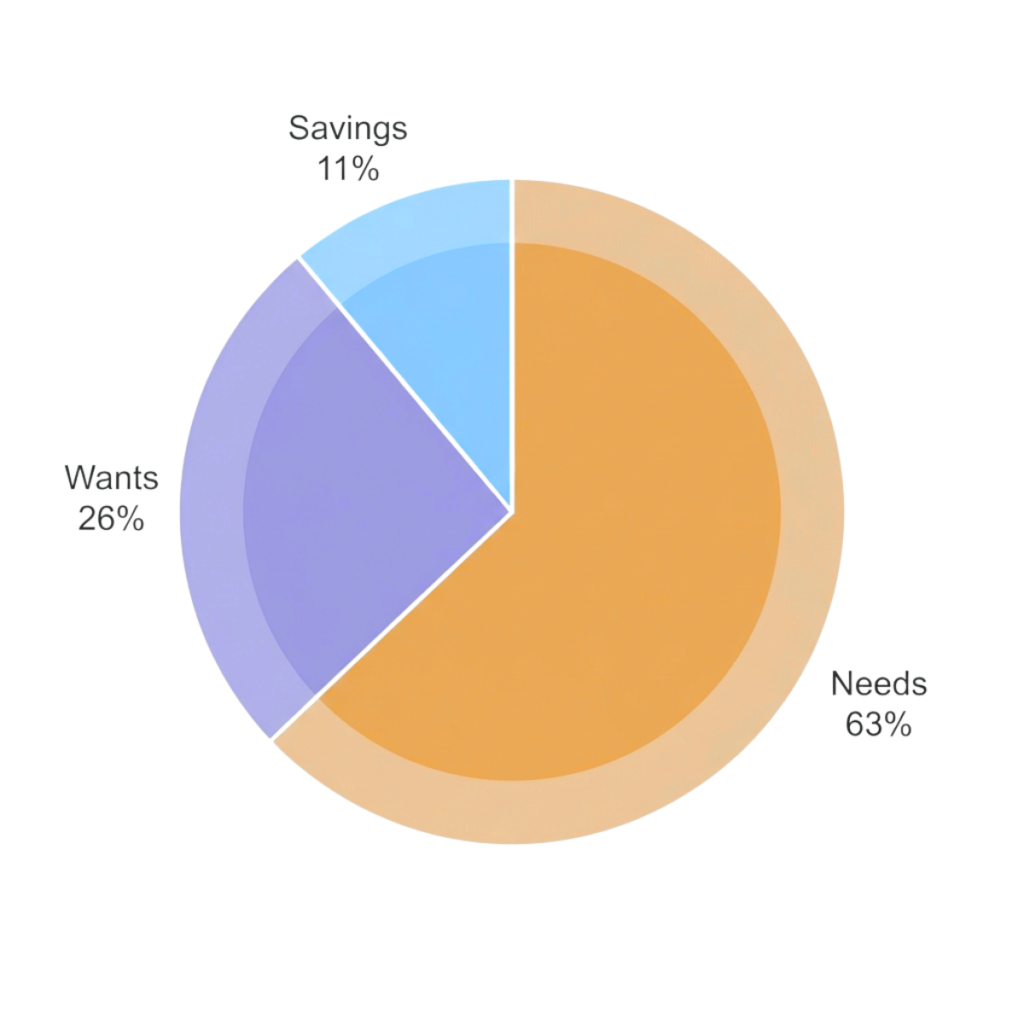
Needs totaled about $2,650 (roughly 63% of income), wants totaled $1,100 (about 26%), and savings landed around $450 (about 11%) — meaningfully short of the 20% savings benchmark in the 50/30/20 framework. Seeing the numbers laid out, Maria didn’t need to eliminate discretionary spending entirely. She reduced dining out and one unused subscription, freeing up roughly $200 a month, and redirected it to a dedicated savings account. That single adjustment, made possible only because she could see the real numbers, moved her savings rate from about 11% toward 16% without a change in income.
This example is hypothetical and simplified for illustration. Actual budgets will vary based on cost of living, family size, debt load, and income.
Benefits and Limitations
Benefits:
- Provides an accurate picture of cash flow, which makes every downstream decision (saving, investing, debt payoff) more reliable
- Reduces financial stress by replacing uncertainty with a plan
- Creates the discipline needed to build an emergency fund and avoid relying on high-interest credit for routine expenses
- Makes it easier to notice financial problems early, before they become crises
Limitations:
- Tracking and budgeting take ongoing time and attention; they aren’t a one-time fix
- A budget can’t manufacture income that isn’t there — for households with expenses that structurally exceed income, budgeting alone won’t solve the underlying gap, and addressing income or fixed costs becomes necessary too
- Rigid budgets that don’t allow any flexibility tend to be abandoned; sustainable budgets need built-in room for discretionary spending and occasional surprises
Common Mistakes and Misconceptions
Mistake: Believing the foundation is about income level, not habits. People at many different income levels struggle with the same core issue — spending without visibility into where the money goes. A financial foundation is available to build regardless of income, though the specific numbers will look different.
Mistake: Skipping tracking and going straight to a budget. A budget built on guessed numbers is usually wrong within the first month, which causes people to lose confidence in budgeting altogether. Tracking first makes the budget accurate.
Misconception: The foundation is the emergency fund. An emergency fund is critical and usually comes right after this foundation — but it’s a second step, not the first. Without awareness of spending and a working budget, it’s difficult to determine how large an emergency fund actually needs to be or how to consistently fund it.
Misconception: A budget has to be complicated to work. A simple three-category system (needs, wants, savings) is often more sustainable long-term than an elaborate 20-category spreadsheet that takes hours to maintain.
Practical Considerations
Building this foundation doesn’t require special software or financial expertise. A checking account statement, a notebook or spreadsheet, and roughly 30 minutes a week is enough to get started. Many banks and credit unions also offer built-in spending categorization tools at no additional cost, which can shorten the tracking phase.
It’s also worth deciding, early on, where a modest starter emergency fund will live. FDIC-insured savings accounts protect deposits up to $250,000 per depositor, per insured bank, per ownership category — a relevant detail once savings begin to accumulate, though it rarely matters at the very early stage.
When This Approach May or May Not Make Sense
For most people just starting to manage money — students, early-career professionals, or anyone who has never formally tracked spending — building this foundation first is close to universally useful advice, because it doesn’t require any prerequisite knowledge or existing savings.
It may need to be adapted for households already in a financial crisis, such as facing eviction or utility shutoff. In those situations, addressing the immediate emergency — often with help from a nonprofit credit counselor or local assistance program — takes priority, and the budgeting foundation gets built once the immediate crisis stabilizes.
It also looks different for someone with irregular income, such as freelancers or commission-based workers. In that case, the foundation still starts with tracking and awareness, but the budget itself typically needs to be based on a conservative, averaged monthly income rather than a fixed paycheck amount.
Key Takeaways
- The first foundation in personal finance is financial awareness paired with a working budget — not investing, not an emergency fund, and not debt payoff, though those come soon after.
- Tracking real spending for at least a month is what makes a budget accurate rather than a guess.
- The 50/30/20 framework (needs, wants, savings) is a useful starting structure, not a fixed rule — adjust it to your actual cost of living.
- High-interest debt should factor into the budget from the start, since its cost tends to outweigh most other financial priorities.
- This foundation is available to build at any income level, and it’s what makes every later financial decision more reliable.
Frequently Asked Questions
Q.1 Is an emergency fund the first foundation of personal finance, or is it budgeting?
Budgeting and spending awareness come first. An emergency fund is typically the next building block, and it’s difficult to size or fund one accurately without first understanding your real monthly expenses.
Q.2 How long does it take to build this financial foundation?
Most people can get a reasonably accurate picture of their spending within one month of tracking. Turning that into a stable habit — reviewing and adjusting the budget regularly — usually takes two to three months before it feels automatic.
Q3. Do I need a specific app or software to start?
No. A basic spreadsheet, a notebook, or the categorization tools built into most banking apps are sufficient. The consistency of tracking matters more than the tool used.
Q.4 What if my expenses are higher than my income even after budgeting?
A budget can reveal this problem clearly, but it can’t solve it on its own. In that situation, the next steps usually involve reducing fixed costs, increasing income, or both, sometimes with the help of a nonprofit credit counseling agency.
Q.5 Should I pay off debt before building a budget?
Generally, the budget comes first, because it shows you how much you can realistically put toward debt each month. From there, many people prioritize high-interest debt — such as credit card balances — before other financial goals, given how quickly that interest compounds.
Q.5 Is the 50/30/20 rule required, or just one option? It’s one commonly used option, not a regulatory or legal requirement. Many households, particularly in high-cost areas, need to adjust the percentages to fit their actual fixed costs.
Q.6 Can I build a financial foundation on a low or irregular income?
Yes. The process is the same — tracking, budgeting, and building savings habits — though the specific dollar amounts and the budgeting structure (often based on averaged income) will look different than for someone with a stable paycheck.
Conclusion
The first foundation in personal finance isn’t a product, an account, or an investment strategy — it’s knowing where your money goes and having a plan for it. That clarity is what makes every later step, from building an emergency fund to investing for retirement, actually work. The most important consideration is accuracy: a budget built on real tracked numbers, not estimates. The main limitation is that it takes ongoing attention rather than being a one-time fix. The practical next step is straightforward — track your spending for the next 30 days, sort it into needs, wants, and savings, and use that picture to build your first real budget.
Financial Disclaimer
This article is for educational and informational purposes only and should not be considered personalized financial, tax, or investment advice. Financial decisions should be based on your individual circumstances and, when appropriate, discussed with a qualified financial professional or a nonprofit credit counselor.